

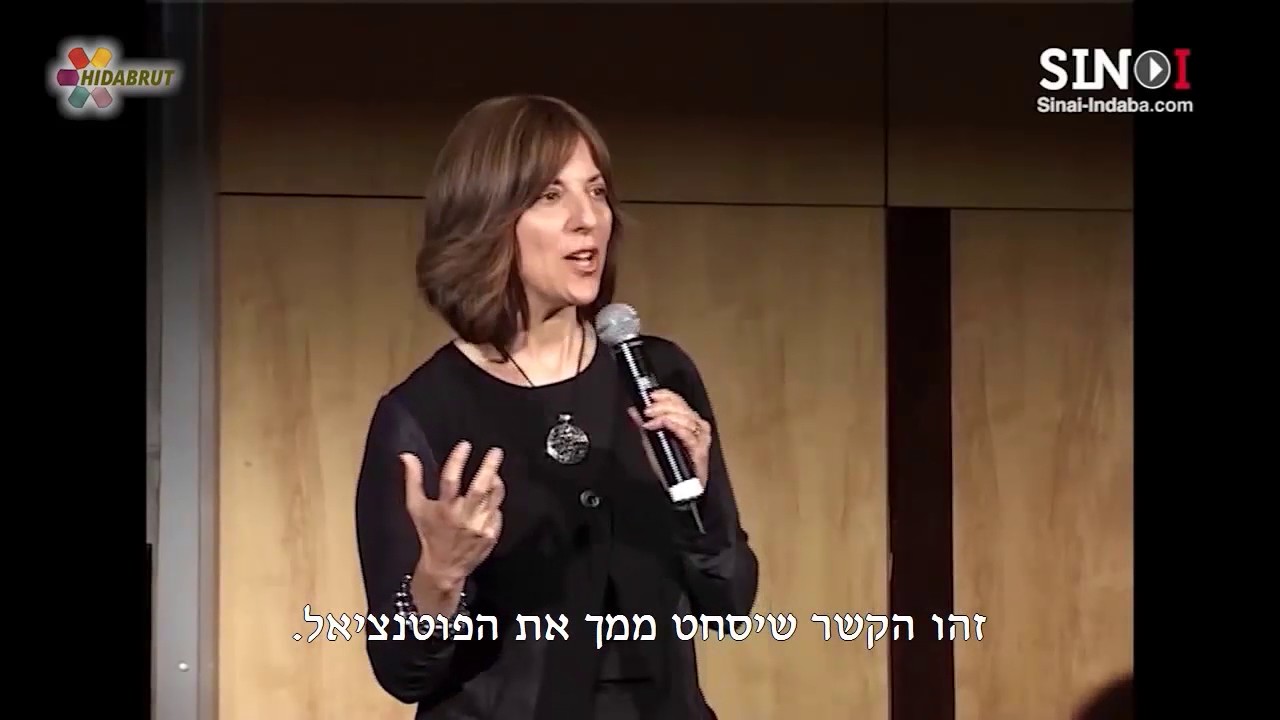
להתאהב ולהישאר מאוהבים - הרבנית לורי פלטניק - עם כתוביות בעברית HD

מה מגיע קודם, האהבה או הנישואין? מהי ההגדרה של נישואין? ואיך משמרים את האהבה לאורך זמן?
When I sit down and meet a young couple who are about to get married, my husband's a rabbi. And when I meet with them, it's usually under they think it's because I'm going to explain the wedding ceremony to them, but really I want to talk about marriage. A rabbi once said, "If only people spent as much time planning their marriages as they do their weddings, we'd all be a lot better off." My first session with them is called Scare Them Straight. I don't tell them that, but in my mind, Scare Them Straight. I asked them the following question. Of all the people walking to the Koopa, how many
get divorced? What what did they say? Half. 50%. And then I asked them, of the 50% who stay married, what percentage would you say have a happy marriage? What would you say? 10%. 5%. Who it was higher in Cape Town. Yeah. Anybody else? 25%. I feel like an auctioneer. Do I hear? Does anybody say 50% of the 50%. Okay. Would anybody see more than that? 75. 75. Sold. Okay. In a married audience, I usually get as low as 10 of the 50%. As low as 10 and as high as 50. I once did a shabatone with 120 teenagers in Detroit. It was very special, me and 120 teenagers. And I actually was teaching them
about the ten commandments. And I got to commandment number seven, which is don't commit adultery. So I said to them, I asked them this question. I threw this out to them. Of all the people walking to the copa, how many get divorced? They said 50%. And I said, of the 50% who stay married, what percentage would you say have a happy marriage? And who are they thinking of? Their parents. You know what they said? 1% 2%. They weren't joking. And I thought if their parents could be here, they'd be scared straight. So I say to the couple in front of me, let's be very generous. And we're being very
generous. And we'll say, of all the people walking to the club, 50% get divorced. And of the 50% who stay married, 50% have a happy marriage. And we're being very generous. That means of all the people walking to the hoopa, maybe one quarter are going to come out with a happy marriage. I say to them, you don't want to be a statistic. Now let's learn. The first thing we have to do and what I share with them is we have to define our terms. We have to define our terms. The Torah is very big on this. You want to be happy, what's happy? You want to be successful, what's success? You must define
your terms. One of the tools I use when a couple comes to me and they're having trouble in their marriage. And unfortunately, this happens a lot, is I take two pieces of paper and I say to them, you write down your definition of love and marriage and you write down your definition of love and marriage. So the woman writes, "Love is marriages." And he does the same thing. Then they hand me their papers. What do I see? two different definitions. Hello. We're in this together and yet we define what we're in together differently. How can we possibly achieve anything? At the very minimum, we have
to have a mutual definition of what we're in. Now, when I first started speaking about this, I would define love first and then marriage, which sounds like the right order, right? Love, marriage, baby, carriage, right? And then I realized, no, no, no, no, wrong order. Anybody here who's been married for a few years. When you go to a wedding today and the bride and groom get up and they talk about how much they love each other, I love him. I love her. And you're sitting there going, "Yeah, right." Yeah. Yeah. They know what love is. They don't know what love is. You can't compare the love I
had for my husband on our wedding day to the love I have for him now. 25 years later, five children later, the loss of his father, all the challenges we have, everything we've been through together. That was like a joke on my wedding day. I knew I was on to something. But come on. So, we can't we can't define what love is first. We have to define what marriage is first. The Jewish definition of marriage is very easy to remember. It's one oneness. That's it. One. It says in Cabala, before we're born, we're one soul. And God splits us. And your half a soul. You go off into this world. And your
other half, your soulmate, also goes off into this world. And when God splits you, he imagine your soul's like a circle. He does not split you like this. He splits you like this. Like two pieces of a puzzle that fit together. And that's why opposites attract. Extroverts tend to marry introverts. People who are organized and detailed tend to marry people who are artsy and flowy. People who like the thermostat up marry people like the thermostat down. Why? Because you're half a soul and you're yearning for completion. When you find the right person, you're finding the part of you that was
always missing. And the same qualities that we're so drawn to in the other person that complete us are the same qualities that later on in marriage make us nuts. Is anybody here like me? An extroverted woman married to an introverted guy? Anybody like me? Okay. Okay. When you're about to walk into a social situation that your husband doesn't want to be at, what does he say to you before you walk in? What does he say? Pardon? Why am I here? Okay. So, you know what my husband says? When are we leaving? I go, "When are we leaving? We haven't even got in yet. We don't even know if we're having
fun. We're already leaving." Yes. For an introvert, being in a social situation is like sucking the air out of the balloon. And it def it deflates them. They get less energy. For an extrovert, being in a social situation is like pumping air into the balloon. You get more energy. Here's the mistake. The same qualities again that we are so drawn to in the other person that we need in order to realize our potential are the same qualities in marriage that make us nuts. Why can't you be more social? Why can't you be more organized? Why can't you be more fill in the blank? Instead of resenting
them, embrace them. Celebrate them. Those are the qualities that the Almighty sent to you to help you to become a great person. I hate to break the news to you, but we don't grow through our spouse's good qualities. Our spouse's good qualities are like the whipped cream on the hot chocolate. Yum, yum, yum, extra. Enjoy. Just like we don't grow through our easy kids, we grow through the challenging kids. When we have to deal with our spouse's challenging qualities, what do we have to draw upon within oursel? We have to be patient and sensitive and supportive and understanding and empathic. If
I told you there's somebody I want you to meet, she she's so sensitive and understanding and supportive. This is a a great person. This equals a great person. You thought you were a good person before you got married and then you got married and your spouse told you you could be better. All right. This is the relationship that is going to squeeze the potential out of you. It's right in your face. Don't make the mistake again of not realizing that these challenges and the and again everybody's got them. Everybody's got the good stuff and everybody's got the challenging stuff. And it's their
challenging qualities that is our road to greatness if we embrace it properly. My husband is so brilliant and so deep. He's a creative genius. He he's unbelievable. But you don't get everything. You can't be like that and also be organized and on on top of every detail. He's like the absent-minded professor. He forgets his car keys. He forgets his passwords, right? He doesn't know that. Understand? Many many times many times when I would come home from a trip, my husband, bless him, would meet me at the airport and then I'm tired. I'm tired. I've flown across the world. I just want to go
home. And then we go to find the car. And I'm telling you, every time we can't he can't find the car. Every time. Every time. And I'm like, for years I'm like again you can't find the car, right? Like I'm so tired. I can't again you can't find the car. And then I realize after well uhuh Lori reframe now when I land I've already budgeted into my mind that we're going to for 35 minutes we're going to have a date. And our date is we're going for a walk to find the car. Okay. And we catch up on the kids and my trip. But I don't expect him to find the car. It's not who he is. He's an amazing
father. He's unbelievably so deep. He's so brilliant. He's such He has so much wisdom and Torah. Okay. So, he can't find the car. All right. Do you understand? You don't get it all. It's how you look at it. This is an opportunity for me to be patient. It's opportunity for me to be understanding to focus in on his good qualities, which we're going to get to. All right. So, marriage is oneness. Under the ka, you become one. And you live your marriage as one. who would never want to hurt the other person because you really are only hurting yourself. What is love? There are three aspects to the
definition of love. Number one, love is the emotion that you feel when you focus in on the virtues of another person and you identify them with those virtues. That's love. I'll repeat. Love is the emotion that you feel when you focus in on the virtues of another person and you identify them with those virtues. You want to love somebody more, focus in on their virtues. It doesn't mean you're blind to their negative qualities. You see this with children. Is anybody here pregnant? Anybody want to announce they're pregnant? Come on. Nobody's pregnant in the audience. Come on. The man puts up his
special place here. Okay. All right. Joeberg. Okay. All right. If you ask a pregnant woman, come on. Is anybody really pregnant? Seriously? Pardon? You want people want it to be a secret? You want it to be a secret? That's over. Okay. Okay. If you ask any pregnant woman Oh, you have somebody pregnant over there. Ah, there we got somebody. Okay. Hi. What's your name, honey? Yeah. Your name? Mandy. Okay. Mandy. Is this your first? You could tell she's got that totally has no idea what she's getting into. Look. Yeah. You could tell the first. Okay. It's great. It's amazing. It's easy. Don't
worry about it. Okay. Okay. It only gets easier. Okay. All right. So, Mandy Mandy, you going to love your baby? How do you know what? You love every baby. Some baby are babies are bratty, snotty-nosed kids. Like, you really love every baby. There's babies you don't like. How do you know you're not going to get one of those? How do you know, Mandy? How do you know? Nobody ever falls out of love with their children. Have you noticed that? Did you Does anybody ever call Jewish Family Services and turn one in? Like, what can I do? I fell out of love. Okay. What can I do? You know why Mandy knows
she's going to love her baby? And why all of us know that we're going to love our babies? No matter how they come out, boy, girl, extrovert, introvert, athletic, creative, easygoing, quick to anger, doesn't matter. You know why we're going to love our babies? Because we made a choice even before this baby is born that we're going to love this baby. Love is a choice. Now listen to the insanity. These babies and we have no idea how they're going to come out and we know we're going to love them no matter what. our spouses who we chose, who we compared to other people and said that's the one
that's the one we fell out of love with. What happened? We stopped choosing. Love is a choice to focus in on their virtues. It doesn't mean you're blind to their negative qualities. Who knows my kids good qualities better than I do? No one. Who knows my kids challenging qualities better than I do? No one. But if you ask me about my kids, I go, "Oh, my shanda, she's she's like this and my Zebie, my I'm not just a bragging Jewish mother." That's how I see them. Even though I'm completely aware of their challenging qualities, love is a choice. I can focus in on my spouse's my husband's good
qualities or his challenging qualities. It's my choice. Do you see how empowering that is? It's my choice. That's the first definition of love. Second one. Second one is what I heard from David Weiss who is also speaking in this uh in this um in Daba years ago. We were both speaking in the United Kingdom at a a huge event and I heard him he's the head he was the head screenwriter of Shrek 2 and he said that he learned from his rabbi who learned from our rabbi that one of the definitions of love is and became the theme of Shrek 2. Love is what's important to you is important to me. And if you
rent Shrek 2, you'll see that that's the theme. I learned this very much from my parents growing up. Talk about opposites attract. How can I describe my parents to you? My mother is very creative, very adventurous. My mother's idea of a great vacation is backpacking in Nepal on 24 hours notice. She's 79. Okay, I'm not joking. She just got back from India. All right. My father's idea of a great vacation is an airconditioned bus tour of Miami he's been planning for six months. get it. I'm actually a very interesting combination of my parents. I have a very adventurous side and creative side for
my mother and a very practical side for my father. So, how did they make it work? How can they be married for over 50 years and be happy because they live this? What's important to you is important to me. My mother, she loves the arts. They live in Toronto. They have a subscription to the Toronto Symphony. And every month, my father goes with my mother to the symphony, holds her hand, and tries not to fall asleep. My father, he's a real Canadian guys guy. He likes hockey. My mother goes with him to the Toronto Maple Leaf hockey games, holds his hand, and tries to pretend this is not stupid,
okay? Because love is what's important to you is important to me. Our middle son, Moshi, Moshi's our jock, okay? Moshi's totally into sports. He's really into sports. Now, we don't have a television at home, but when I travel, I always turn on ESPN. Why? So I can come home and say, "Moshi, I saw Shaq and his neck is like this, and I saw Kobe and all his tattoos, and I saw the mailman." You know why they call him the mailman? Because he delivers. I know this stuff. Okay? And when I say this to Moshi, Moshi's eyes light up. Why? He knows I don't love sports, but I love my Moshi. And love is
what's important to you is important to me. Third definition of love. Rabbi Desler asked in his work, Strive for Truth, does loving lead to giving or does giving lead to loving? I love you, so I give to you. Or the more I give to you, the more I love you. And the Jewish answer is, the more you give, the more you love. You see this with children. Now, you'll notice by my snotty-nosed bratty um comment that not really so into babies. All right? I happen to love my own babies, but I wasn't one of those people who grew up and like was a babysitter and really into babies. So, I was a little bit
concerned when I started having my own children. Turns out you love your own babies. Yay. All right. So, I had our first baby Shosana. I when they handed me Shashana in the hospital, I was completely overwhelmed at how helpless babies are. They can't do anything on their own. They can't feed on their own. They can't clean up on their own. They can't roll over on their own. You got to burp them. Okay? They can't even burp on their own. Why did God make it that way? It could have been like the animal kingdom. A deer has a fawn. The fawn nurses a little and goes has a life. Why did God make it
with human beings that they're so helpless? You know why? So, we'll give and we'll give and we'll give and we'll give. And what do you get back for the first few months? Oh, you get something back. Sleepless nights, throw up down your back, diarrhea down your front. Mandy, don't listen. Okay. Not your baby. And you love this baby more than life itself. You throw yourself in front of a truck for this baby. The more you give, the more you love. You want to love somebody more, be a giver. When I was engaged, uh, Rebbitson Torski, who is a real Repson, she's the real deal from Milwaukee. She's
from the Torski dynasty. She has a tremendous marriage. She's a very wise woman. She's somebody to ask wisdom of. She came to Toronto when I was living there and to speak for a if you ever want to spend time with the speaker, ask to drive them to the airport, right? It's like it's a trick because you can't usually get any time with the speaker. So I said to Aish, I would like to drive Revs and Torski to the airport. So they were happy. They didn't have to deal with that. And I got Revs and Torski one-on-one. So now I'm driving to the airport. It's a short drive in Toronto from the A center to
the airport. And I'm telling her my whole life story, you know. So then we get there and I say to her, I'm taking the the the suitcases out of her trunk. And I said, "Revitzen Torski, if you could give me one piece of marital advice, what would you give me?" She says, "I'm going to give you the advice that my brother-in-law gave me the night before I got married." She said, 'You should wake up every morning and the first thing you should think is, "What can I give to my spouse today?" And I said, "Oh, okay." She goes, "No, no, Lori. You think it sounds simple. One extra act of giving a day, a
it could be a small little thing. It will add up to hundreds of thousands of giving in a marriage. And unless, god forbid, you're in an abusive marriage, don't worry about receiving. When you're in giving mode, you create an atmosphere of giving. We become givers. And the more you give, the more you love. So, I once gave this assignment. I was living in Denver, Colorado for four years. And I gave this assignment to a group of women I was learning with. I said, ' Okay. So, now our assignment is we're all going to this week do one extra act of giving for our husbands and we're going to report
back next week. So, the next week we got together and I said, "Who did their assignment?" And one woman goes, "I would like to share what happened." I said, "Sure." Because they're Americans, they share, not like South Africans. All right. Okay. All right. So, so she said, "I would like to share." She says it was Wednesday and I had not done my homework yet on that day and I realized, "Oh my gosh, it's the evening and I haven't done it yet." So, I was making a cup of tea and I said to my husband, "Honey, I'm making a cup of tea. Would you like a cup of tea, too?" He's like, "Yes, I would."
The next day, she said he was making a cup of tea. And he said, "Sweetheart, I'm making a cup of tea. Would you like a cup of tea, too?" She's like, "Yes, I would." She says, "This works. The more you give, the more you love." All right. So, now we have our definition of marriage and our three definitions of love. Now, we're going to move on to the most popular part of my dating workshop, which I've given to thousands of people all over the world, is the three questions you have to answer yes to in order to know it's the right person. It's not in any order because you have to answer yes to
all three. It doesn't matter. There's not a priority order in my dating workshop. So, for those of you who are single or advising people who are single, these are the three questions you must answer yes to to know it's the right person. For those of us who are married, if you answer no to one of these questions, do not leave the room and turn to your spouse and say, "I knew it all along and Lori just confirmed it." All right? Don't do that. They will never invite me back. All right? For those of us who are married, these are the three areas that we have to put a lot of time and effort into in
our marriage. Got it. Okay. Question number one. Do you have the same goals? And I don't mean we both want to get married and move to the suburbs and have a three-car garage and go south once a year, north once a year. I mean meaningful life goals. Not just do we want to have children. What values do we want to give our children? Not just what does our house look like? What does our house feel like? What do we want to contribute to our community, to our people? Somebody came up to me after a dating workshop and she goes, "I don't know if the guy I'm dating has the same meaningful life goals
as I do because I don't know what my meaningful life goals are." Starts with you. Until you know who you are and where you're going, you don't know who to go with. My day-to-day goals are very different than my husband's. I'm doing a car lift scheme. I'm doing a lift scheme. I'm I'm meeting somebody for coffee. I'm counseling somebody. I'm finishing a chapter for my publisher. I'm doing another lift scheme. My husband's a rabbi. He's being a rabbi all day. He marries people. He buries people. All right. But our day-to-day goals together that we want to contribute something to the Jewish
people. We may do it in different ways. This is not just a nice thing for the Jewish people. This is good for our marriage. Do you understand? When I was dating to get married, again, it's who you know who you are and where you're going. You don't know who to go with. For me, because I'm extremely idealistic, for me, when I first started dating, I was like doctors, lawyers, accountants, I realized I can't marry one of these guys. For me, for some people, being married to an accountant is the perfect thing for them. But for me, no. If I married an accountant, what would I say to him at the end
of the day? So, honey, everything add up? Okay. because of who I am and because even many years ago I was driven to do something for the Jewish people. I needed somebody who didn't just say that's nice dear. I needed somebody who was who was with me who was a partner in this. All right. So number one, do you have the same goals, meaningful life goals? Number two, are you physically attracted to each other? The toolman said this is a very very very very very very important part of a marriage and not just for the first years until the kids come and then this is actually supposed to be getting
stronger in a marriage and not weaker. In the Torah when it says that a husband is intimate with his wife it says and he knew her. The more knowledge the more love the more love the more desire for each other. But men and women often look upon this area differently. Now, I'm going to generalize right now. What does generalize mean? There are exceptions. All right? But in general, for a woman, attraction to the man is very much inside out. And for a man, it's the opposite. It's very much outside in in general. General. Imagine. Imagine you're single. Girls, I'm talking to ladies now. Okay?
girls, you're single and you're standing at a party with a friend and you see a guy across the room and he's hot, which is a very regional term, I have to tell you. I speak all over the world. If I say hot in London, they're turning up the air conditioning. Okay? In London, he's fit. In Costa Rica, he's wipo. In Brazil, he's a cat. I once spoke to a deaf audience. He's this. Okay. Okay. But you said I found out you say hot here, right? He's hot. Okay. So, you look at and your friend sees you looking at him and she goes, "He's hot, isn't he?" And you're like, "Oh my gosh, he's so hot." And she
says, "He's my cousin. Do you want to meet him?" Totally. Of course, I want to meet him. So, now you're going across the room with her and you're like, "Okay, no, I can't do it. I can't do Okay, okay, okay. Okay, okay, okay." And then you get across the room, your heart's beating out of your chest, you have no saliva in your mouth. She introduces you to the guy and she slips away. Now you're talking to the guy. A few minutes in you realize porch lights on. Nobody's home. Okay. Somebody said body by Nautilus, brains by Fisher Price. Okay. For a woman in general, you're not even physically
attracted to him anymore. It's different for a guy. He sees a girl across the room, she's hot, there's nothing. He still wants to be with her. All right. It's true. It's true. In marriage, it's also the same in marriage. For a woman, how he treats us outside the bedroom is directly related to how we will treat him inside the bedroom. And for a man, it's the opposite. How she treats him inside the bedroom is directly related to how he treats her outside the bedroom. Do you hear the problem? Okay, somebody has to make the first move here. And don't wait for it to be the other person. So for a
woman, if he's supportive and understanding and a great father and considered outside the bedroom, that directly relates to how she will treat him inside the bedroom. I'm going to give you an example of how romance can change in a marriage as years go on. There's still romance, but it changes. I'm going to give you an example that you're not going to be relate to because you live in South Africa. It's about housekeeping. Okay? So just imagine, okay? Imagine a life without maze. I have to tell you, Rabbi Kheim Willis, he is the head of Asia here in Johannesburg. He is my husband's best friend.
He brought my husband into a My husband became religious through Rabbi Willis. My Rabbi Willis made our shittak. He introduc I met Rabbi Willis. He introduced me to my husband. He changed our life. We have tremendous gratitude to him. And whenever he asks us to do anything, even it's flying across the world and speaking non-stop morning, noon, and night, we always say yes. except when he asked us to move to South Africa about 13 years ago. They made a big push that we should move to South Africa and it was a big big push and in the end we decided it was just way way way too far away from our
elderly parents and we said no and it was hard to say no to Rabbi Willis but one of their pitches was Lori you'll never do laundry again. And I was like that doesn't matter to me. Can I tell you 13 years later every time I do laundry I think I'll never do laundry again. Okay. But I'm fine with that. Okay. Fine. All right. So, I'm one of those people. I don't mind doing laundry. I really don't mind it. I don't like putting it away. I don't mind shopping for groceries. I don't like putting them away. I don't mind loading a dishwasher. I hate unloading dishwashers. It's just the way I am. One
night when our children were little, my husband went to bed. My kids are asleep. And I don't like to wake up to a messy kitchen. So I decided I'm going to clean up the kitchen. Now I have to unload the dishwasher and I hate unloading dishwashers. I open the dishwasher and it was empty. Now we didn't have help. My kids are little. Who unloaded the dishwasher without me asking? My husband. I have to tell you, I got this wave of romance from my husband at that moment. I was like, "This is sick. An empty dishwasher." Okay. Yes. I gave this talk in Minnesota and it was a marriage talk and we were
all in a room and there were like round tables with wine and candles. There's probably like 50 couples and I gave this marriage talk and I gave this example and the next morning I met with the women of the community and they told me that the night before when they went home their husbands ran to the dishwashers. Okay. Look honey. Look, look, look, look. Okay. Revitzson Weinberg came to Toronto many years ago when we were living there and she met with the Asia Rebbitson and she was very very strong about how important it is to keep this part of our marriage strong and this doesn't just happen.
You must put effort into it. And she says, "One of the mistakes we make is that when we go out, ladies, how do we how do we dress when we go out? We dress great. We're up, right? We dress up. You look beautiful." Right? You dress up. And then we go home and what do we do? We dress down. Okay? You put on your sweats. What? Right? Listen, our husbands are out there all day long interacting with women who went out and they look marvelous. And then he comes home to us. Now, it's not like he's gonna walk in and you're in your sweats and he's going to call up the bastin and forget. Okay. But this
is chip chip chip chip away at the fragile Mingvos called our marriages. And enough chips will cause a crack and enough cracks will cause a break. She told us that every night when her husband, Rabbi Yakov Weinberger, of blessed memory, when he would drive up into the driveway, she would run to the bathroom, put on fresh lipstick, spray perfume, fix her hair, and go to the door to greet her husband. And night after night, their kids saw their father would drive up to the driveway. She would run to the she would run to the the mirror, lipstick, perfume, hair, and go to the door to greet their
father. One night she said she was very tired and she fell asleep on the couch and her husband drove up in the driveway and the kids panicked. Tati's home and mommy's asleep on the couch. She says she woke up and there was shmearing lipstick on mouth spraying perfume whenever he is. It's a funny story, but listen to the message. Their kids saw night after night that their mother cared more about their father thought of her than anyone else in the world. The Torah also has a system that is almost a guarantee to keep this strong. It's the system of Tahara Mishbah, the laws of family purity,
mikvah, which is basically an on-again, off-again system in terms of intimacy. I've had more than one friend who was having trouble in the bedroom and went to a therapist who specializes in this and I was curious and I asked them, "What did the therapist say?" And they told me the same thing. They say the first thing if you go to a therapist who specializes in this is they will tell you abstinence and slowly slowly slowly they bring you back together. God does this every month. And the tommet says to a man keep the laws of mikvah so that your wife will be like a bride to you every month that
you'll have the desire for her every month like you had on the wedding night. This is also proof, and I know Rabbi Kellerman has a much more intellectual and scientific and rational approach to the divinity of the Torah, but for me, this is proof that God wrote the Torah and man didn't because man would never write this in. Okay? See your local Rabbi in Rabbitson for more information on this incredible, beautiful, amazing mitzvah. All right, third question. Third question is different for a man than for a woman. For a woman, she comes to me. Is this the one? Is this the one the most important
decision you'll ever make in this world? Is this the one? So, first first question, goals, yes. Physical attraction, yes. And then without him in the room, I look her in the eye and I ask her, do you respect him? And if she answers yes immediately without hesitating, then this is it. But if I say, do you respect him? And she goes, yeah, I worry. Or if I say, "Do you respect him?" and she says, "Yes." But she looks away when she answers. I also worry. A woman came to me in Denver. Is this the one that was one? Yes. Yes. Yes. Do you respect him? She goes, "Yes." And she glanced away when she
answered. Now, I don't have my doctorate in behavioral science. But if I ask you a question and you look away when you answer, you're lying. So, I probed and there was something about him she did not respect. She married him anyway and then she divorced him. It is a very very very very big deal for a man that his wife respects him. Why? I have no idea. I have my theories. Ego society. It doesn't matter why. It just is. He can be the CEO of a corporation and people are bowing down to him all day long. But if he comes home and his wife doesn't respect him, it's not good. Ladies, I'm going to
give you respect 101. Now, this is basic basic basic respecting your guys. If if you're not doing this, don't even come to me. I don't want to talk to you. Basic respecting your guy. Imagine Oprah Winfrey has chosen you for an inc camera interview in your house. And now's the day that Oprah and the camera crew are coming. How do you look? You look great. How does your house look? Great. Okay. So, now you're talking to your friend, waiting for Oprah and the camera crew. Dingdong. Oh my gosh. Oprah's here. I'll call you back. Oprah. Oprah. This is the most exciting day of my life. This is
great. What can I get you? This is great. Oprah incoming. Regular day. You're on the phone with your friend. D. Your husband walks in. D. When your husband comes home, get off the phone. And he should hear you say, "Oh my gosh, my husband's home. I got to go." Click. What message are you sending to your husband? You are more important than anyone else on the end of this line. And it's true. There are two exceptions. Number one, it's his mother. Then you go, "It's your mother." And you hand him the phone. Number two, it's an emergency. People don't realize that rabbis and rebbitons also have
lives. And I remember that I was living in Denver, Colorado, and I had a week that was, it was one of those weeks where everything hit the fan. Shabas morning. Somebody comes over to me during Kdish and says, "Lori, I called you three times this week and you didn't return even one of my calls." I go, "My dear, I had one of those weeks that unless you left me a message, my husband's having an affair or I'm converting to Catholicism, I'm not calling you back." Okay, so the next time she left me this message. She left me this message. Hi Lori, it's so and so off to mass. Call me. Okay, that's an
emergency. Otherwise, get off the phone. And sometimes we're not on the phone. And you hear your husband. Guys, don't listen to this. You hear your husband drive up. You pick up the phone. Oh my gosh. My husband's even when they know you're lying, they love it. Okay. I travel back city to city and husbands have told me that this is the number one thing that improved their marriage. Such a small thing. What's the question? Because what does a man need? A man needs to be respected. What does a woman need? A woman needs to be loved. A man wants to be loved but needs to be respected. And a woman
wants to be respected but needs to be loved. So what do we ask the guy without the girl in the room? We ask him, "Will you be happy making her happy for the rest of your life?" Every man needs a job. A man's job in marriage is to make his wife happy. But ladies, you have to give him a break. You didn't marry a mind readader. You have to help him to understand what makes you happy in a way that builds him and doesn't diminish him. True story. My husband and I met 25 years ago in Israel at the beginning of January. Got engaged at the end of January. Got married in June. And now it's October and
it's it's my birthday. Okay. My husband remembered it's my birthday. You got to give him that. And he hands me my present. I open it up. What did my husband give me for the first birthday we're celebrating as husband and wife? a food processor. The men are like, "That's a good idea. Food processor." Okay. No, no. A food processor for my birthday. I was devastated. But he must have heard me say as we were setting up house after all the showers, gifts, and and the wedding presents. I don't have a food processor. I need a food processor. My husband's a man. She needs a food processor. Okay.
Okay. But that's not what you get your wife for her birthday. I realized he's all smiles. I realized he has no idea he blew this. So I said, "Thank you, honey. I needed a food processor." And I waited for him to leave the room. And I called up my friend Esther. I go, "Esther. Yakov just gave me my birthday present." She goes, "What'd you get? What'd you get?" I said, "A food processor?" She goes, "Oh, you poor thing. I'll take care of it." So she told her husband to fry him. They had been married a year before us. He worked my with my husband Yakov at Aish. He waited a couple weeks and
mentioned in passing that women like perfume and jewelry for presents. Perfume and jewelry. Okay. So, the next time we had something to celebrate, he got me perfume. And the next time he got me perfume. And the next time he got me, I go, "Honey, we just used a tiny little bit." Okay. Then we go to jewelry and there's no turning back. Okay. We're good to go. We're good to go. Again, you want to I asked my rabbitson, "What's my job as a wife besides the obvious?" She says, "Your job is to take a good guy and make him great." I go, "How do I do that?" She goes, "By pointing out his mistakes in
the very best way possible." And most of the time, it's not by telling him you're making a mistake. They can take that as criticism. And this is not good for them. So, you go around that. Be smart, ladies. Be smart. All right. We're out of time, so I'm going to fast forward. Fast forward. This is not my talk on soul in the afterlife, but at the end of soul in the afterlife, we talk about who do you spend eternity with? I asked my rabbi, Rabbi Noinberg, a blessed memory. He says, you you have a connection to your parents and a certain relationship with them, and you have a connection to your
children in a certain relationship with them, but the person you really spend eternity with is your spouse. Now, some people look happy and some people Okay, and I told this to my friend Sandy when I first learned this in Toronto and she has a very good marriage. But she goes, "My kids, I'm not with my kids." I go, "Sandy, it makes so much sense to me. You give and you give and you give to your children and you're a success as a parent if they do what? They grow up and leave you. If they're 35 and living in your basement, something went wrong." Okay? But you give and you give and you give to
your spouse only so that they'll come close to you. If you grew apart, something went wrong. What is this teaching us? Choose wisely and work like crazy at your marriage. What you put into your marriage in this world is what you will reap for eternity. Thank you very much. All English lectures are available online atro.com.
התמלול נוצר אוטומטית ועשוי לכלול שגיאות.
פורסם ביום שני, כ״ב באדר התשע״ז (20.3.2017). משך: 41:01
0 תגובות
תגובה מתפרסמת אחרי אישור של המערכת.
עדיין אין תגובות לשיעור הזה. אפשר להיות הראשונים.