

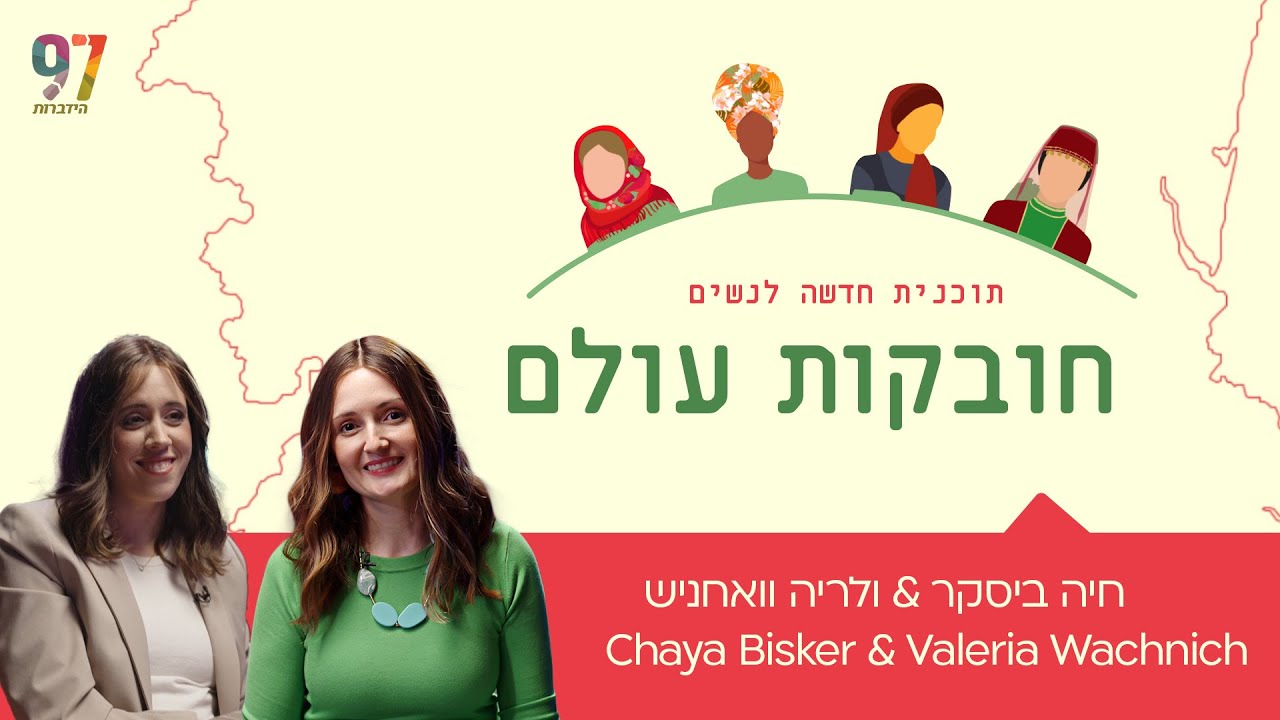
ולריה וואחניש: מארגנטינה לישראל, מסע של אמונה ודיפלומטיה

הכירו את ולריה, רעיית שגריר ארגנטינה בישראל וחברה קרובה של נשיא ארגנטינה, חוויאר מיילי. סיפורה הוא מסע מעורר השראה של אמונה, התמודדות ושינוי, תוך שילוב משימתה הדיפלומטית עם תובנות מחוויות חייה המאתגרות ביותר.
פרקים בסרטון:
Shalom all. Welcome again to Embracing the World. The program that unites Latin America to the heart of Israel. Thank you for being here, again. Today, I am very honored to present you a woman who is example of resilience, faith and strength. A woman who carries a story of a quick transformation, a life that changes and a message, to live in the present, that I hope you will be able to enjoy and learn from. Welcome, Valeria. Thank you very much for invitating me. Happy to be here. Thank you Valeria, thank you for being here at Embracing the World. Valeria Wahnish, the wife of the Argentinian
ambassador to Israel. You came to Israel, not so long ago. Tell us, how long have you been here? We are very happy to be here. We arrived only three months ago, three months and a bit. To tell you the truth, it feels to me much longer. So many things have occurred in these three last months. But, yes, we have arrived merely three months ago. I came with my husband and my six children. Incredibly, we all have a functioning life, each one in their school, with their routine, with their things, therefore, I can say, we are very, very happy to be here. Wow, impressive. Valeria, you were born in
Buenos Aires. Correct, I was born in Buenos Aires. I am 42 years old, I was born in the quarter of Belgrano, in a typical Ashkenazi family, very proud of its Judaism, but not too connected to the religious aspects of it. However, I was brought up with a Jewish identity. I have a brother. I always attended to public schools in Argentina, State schools. I did not have a Jewish education, as such. Still, at home we still celebrated Rosh Hashana, Yom Kippur, in a very light way, not strictly religious. However, I have always known to be Jewish, with great pride. Very nice. How was it? How did you
get closer? How was it getting closer? I truly believe that every person who gets closer to Judaism, has a very impressive history. It is a gift by Hashem. I believe it is a gift from Hashem, because, to tell you the truth, my Judaism was not connected from a spiritual place. It was just an identity, like a person is... I don't know, one could be from Uruguay, one could have different origins. I knew I had Jewish origins, but not more than that. In the quarter Belgrano, there are lots of Yehudim, and I had in my school, in my year, a large number of schoolmates Yehudim. One of them, took me
to a lecture by Rabbi Oppenheimer. This was as I had discovered a completely new world. The truth is that I didn't understand what was happening, but I understood, my Neshama connected with the fact that something is here, something very special, which is worth exploring. And very slowly, I started studying. I started studying, and I started studying, and learning, however, I was not implementing, I didn't practice what I learnt, I was only 16 years old, 17, I was a girl, You were very young. -I was very young. But I began following the lectures, and very slowly, I started absorbing things.
And how did your family feel about your transformation? At the beginning it was difficult, because, in general, I think parents always wants for their children to follow a path similar to theirs. Also, for them it was a real surprise. They had not had a deep Jewish education either. Therefore, when I came with new ideas, at first, what they said was: "No, this girl... This girl is crazy." I remember that we lived on the tenth floor, and when I started to keep Shabbat, I would walk up the stairs. I didn't want to tell my parents, I didn't want to bother them. One day a neighbor, told my mom.
She told her: "Wow, what an athlete your daughter, walking up the stairs." So, my mother: "Valeria, you are crazy." So, that, no, at the beginning, it's been hard for them. How many floors were they? Ten floors. Ten floors in Argentina: "Why? How come you use the stairs?" You were the only one. The only one, for sure. Wow. -I wasn't doing it for sport. So, for my parents... at the beginning, it was difficult to understand what was all about. They also were afraid, because a young 17-year old girl, now I, as a mother, of teenagers of my own, I do understand it. I understand that to desire such
a deep change, one must feel sure to be in a safe place. My parents didn't know that environment. So, at the beginning, their concerns didn't make it very easy for me. But, well, with time today they are sincerely very happy, of the family we have, and they respect us very much. We respect them, because, until today, they are still not religious, but there is a connection built on a lot of respect, and a lot of understanding. Well, you converted to be a Rabbanit. I converted to a Rabbanit. Later, at the age of 21, you got married. Yes. -With a rabbi. At the time, he was not a rabbi, he was
still a student. He studied at a Yeshiva, he studied the whole day. We met through a common friend, we used to go to the same community. We used to stare at each other, we got to know each other. We also met at university, because we both have a profession, we studied Psychopedagogy. Wow. When I started university, my husband was already finishing, and on his way to Israel. He went to Israel and... Well, when the time arrived, and people started wanting to present me someone, his name came up, and that he was in Israel. So, when he came back, we met, we went out and... I mean, we already knew
each other, but... We started to go out officially, and well... You knew he was the one? Yes, since I met him, I said... I want someone like him. I want someone strong in his Judaism, but at the same time, has a profession, someone who with an open mind. After all, yes, I became religious, but I still live in both worlds. I didn't completely disconnect from my past life. And I felt, I needed someone like me, who had a similar past, and has a similar mentality, so not to have to cut off from any of the two worlds. After you got married, did you live in Buenos Aires? Yes. -Always? We stayed in
Buenos Aires. Well, first of all, we completed our careers at the same time, because my husband was still missing some classes, and at the end, we graduated on the same day. In the first years, he used to study the whole day, as an Abrech. I also studied at university, they were difficult years. Then, 12 or 13 years ago, he was offered the opportunity to be the rabbi of the Maroccan Kehilah in Buenos Aires. Before that, he had always worked in the Community, he had taught lessons, he was Rosh Yeshiva in Quiru, in Sucath David, in Camargo, you can say, he had worked in various institutions,
until this opportunity finally arrived, to go back to his roots, because it was the Community he was part of in his childhood. My husband has Maroccan origins. Well, the truth is that everything happened at a funeral he went to, the Community was abandoned, didn't have a rabbi, a newly built Comunity, very nice, without a rabbi, so well... The Shiduch worked, the Shiduch worked little by little, and thats's where we spent the last 12 years in Argentina, practically, building this Kehilah. All my children grew up there, we had their Bar- and Bat-Mitzvas The births, and you could say, we
cherish a lot of love for this Kehilah, and we miss it very much. How was life as a Rabbanit? Because this is a communitarian, leading role, too. How was it for you, being also a professional, a psychopedagogist, and a mother, too? How did you approach this comunitarian life? Yes, there were really very intense years, the children, Baruch Hashem, were still young, one came after the other. Also, I worked at schools. Well, I tried... I used to teach classes, once a week, not too often. But we used to have many guests at home. We used to host lots of boys for Shabbat, even today some approach
me and ask me: "Do you remember that I was in your house?" I tell them: "Sorry, I don't remember." The truth is that many, many people have been guests in my house, with lots of joy. I mean, I think that since my home, I could always keep my doors open, and be connected to the Community, since then. At the beginning, when we were just a few, I used to go, cook for events, organise, I was autonomous there. Baruch Hashem, then I grew and well, I needed a bigger organisation, right? But... So, with lots of love, always, with lots of love I opened up and gave myself to people. Very nice. It is
the growth of a community, that you both practically created together, from your home. Yes, exactly. You are mother to six children. The last pregnancy brought you an experience, that completely changed your life Do you want to tell us a bit about it? Yes. Well, Baruch Hashem, I had my first five children, one after the other. Three boys, then two girls. When she was younger, Chani was five years old, a little bit after the pandemic, the pandemic started in 2020, in 2021 I got pregnant, of the little one, Shuli. In the middle of the pandemic? -Yes. Yes. In 2021, full pandemic. -In 2021, full
pandemic. It had just started to loosen up a bit, we'd go out of the house... I got pregnant, then. It was a pregnancy, that since the beginning, I felt it was not going so well, but I would have never imagined what later happened. I felt sick, tired, very weak, but okay, I was 38 years old, 39. People would tell me, Well, pregnancies in your 20s are not the same as a pregnancy now... Of course. -...at thirty and more. So, well. -And with such an active life. Moreover, I continued to work until the last day. With five children. Exactly, I carried on with my life as if nothing happened.
Pushing myself to the limit. Yes. Until when, around the sixth month of my pregancy, I started feeling pains that I didn't really like, they were very strong. However, when I went to checkups, at the clinic or by my doctor, they did the tests a pregnant woman could do, an ultrasound, blood tests and everything came out fine, and therefore, they sent me home, telling me that it was a bit of gases, normal disturbs in pregnancy. In the seventh month, in December 2021, I could not go on anymore. I mean, I carried on, but beemet, I could not anymore, I couldn't lay down in bed, I couldn't breath,
I felt a pressure in my belly that wouldn't stop. I went back to the hospital, they did some more tests and told me again it was nothing. It was unbelievable. I remember a sentence my doctor told me, in that moment. He told me: have here "Valeria, we only your pains, because everything is fine." I kept on thinking about this sentence, how a woman must connect to her body and what happens with it and not let it be, because one woman knows, one must know her body, and know how to read what it is telling her. Of course. Your pain was not just a small thing, it was not only your pain, it was
everything. It was a pain, yes. -Yes. When did the miracle happen, that they discovered what it was? What happened? On December 30th, actually a few days before, I started having a fever. I had a fever, and this very strong pain goes away. Therefore, on one side, I was relieved, but on the other, I was thinking this is really weird, it cannot be. I told my husband, I told him: "Do you know what I feel? I feel like when someone has a muy abscessed molar and has an internal infection, the infection, and suddenly the infection goes up, and the pain calms down. But there is still an infection
that needs to be cured. I didn't know what was happening in my body, but I told him: "I feel something like that." How could I feel a pain, then suddenly a fever comes, and the pain goes? I didn't like it. Baruch Hashem, Hashem protected me. I got an appointment with an excellent gastroenterologist, on the same day, and he was the one who said: "Okay, here there is something I don't like." I went back to the clinic with fever, they sent back home, again. No, it cannot be. -Yes, yes, yes. It was Covid time. People were sent back because of Covid. All the medical system was crashing. But, okay,
at the end, they did an ultrasound and this great sonographer tells me: "Vale, here there is something I don't like, I see liquid. You must hospitalize yourself and take care of this." Were you already in the eight month? I was in my seventh. Thirty weeks of gestation. Wow. -Thirty weeks of gestation. So, I go with my husband. This day, December 30th, we had planned to go on holiday, to a home, that is that my kids were with the open suitcases, something completely unexpected. Yes. The fact is that after insisting a lot for them to hospitalize me, with all the confusion due to Covid, with the
hospital full of people, they finally took me in. And what happened was that I went into a septic shock, meaning I had a general infection. My body did not respond anymore. I had a very high fever. Something like 42, 43 degrees fever. I was in an extreme situation in which I was certain, certain that that's it. This was the end. I won't go beyond here. I was hospitalized. I remember that I told my husband, I told him: "Ok, go back home, say bye to the children." I said Shemah, I did Viduy, clearly that... I was delirious, because I had very, very high fever, but I was still conscious, and I
felt this was the end for me. Suddenly, many doctors came to my room, they were looking at me, quiet. No one told me anything, and I was thinking: "No one tells me anything." What is happening? -What is happening? It was a very, very very extreme situation, from which, Baruch Hashem, I managed to come out of this very high fever. They managed to stabilize me. And well, when they take me to do more emergency tests, an ultrasound. The doctors saw that they had to operate immediately. An obstetrician came, not mine, I didn't know him. He told me: "Vale, you are going into surgery" No one
explained to me anything. "We will deliver your baby and operate on you." I didn't even know why. No one until then had told us. However, after everything that happened, one gives oneself completely to the situation. So, I went straight to the operating room. Baruch Hashem, my daughter was born, and they could operate on me. I came out awake, and from that moment my recovery was very fast. -Good. Yes. -Baruch Hashem. It was a hard month, but, well, that's when everything, that comes next, began. What happened next? Well, I recovered very quickly. A week later, my daughter, who was in the
NICU, my daughter was safely born, with a weight of one and a half kilos, 30 weeks, obviously premature, had to stay in the NICU. However, after a week, she had an episode of thrombosis, she had a mesenteric thrombosis. A thrombosis, in the intestines, too. Wow. Like me. I had colon cancer. I don't know if I said it. -No. Was it a tumor? It was tumor in the colon. Big. -Big. The size of a tennis ball. Wow, it explains the pain. Finally, when the colon perforated, that was when I started feeling relief, but had started with fever, because I had a general infection in the body, that brought me
to... Did you have to go through chemo? Later yes. Yes. And the baby? Well, the baby, well, in the week she was born, she had another unexpected episode. She had a septis that caused the necrosis of 70% of her intestines. A newborn baby, very small, one and a half kilos, premature. The doctors were not sure whether she would go through the night. How many times, I went to visit her with my husband at the hospital, and we said Shemah. We said goodbye, as we didn't know, whether we would see her the next day. She was in a very delicate condition. And you went back and forth from and to the
hospital? For sure, I went every day to the hospital, back and forth, recently operated, I could hardly walk. I was very very weak, emotionally weak, too. I still didn't know about my situation. My husband hadn't told me anything, and I had never asked, what had happened to me. These are things that-- -You didn't know until that moment? I discovered my diagnosis, two weeks after giving birth, when the result of the biopsy arrived, that said, everything was fine, at that moment. I was sitting with my husband, one day, and he tells me: "Vale, you know the surgery you had?" "Yes?" -"It was a
malignant tumor." "What?" "Thursday we will go to the oncologist." "What? How, no..." -Wow. Actually, it had been a gift, knowing about it only later. Many people who learn about it during a doctor appointment, or they feel sick or after a test, and get a diagnosis, they get very scared after hearing the results. Of course. -In my case... You skipped all the stress. Yes. It's like, I discovered it in the aftermath. The pains were already over. They had already operated on me, they had already taken the tumor out, so I discovered only later. But okay, we said how do we fight it then, mine, and
how it continued. And the situation of my daughter that was completely... Uncertain. -Uncertain. Completely uncertain. I remember that when the doctors came out from her operating room they told us: "Okay, your daughter, has an intestine, extremely short." They drew a drawing. "These are the intestines. She doesn't have all these, the middle part. She has left this little piece above, and this little piece at the bottom. She has very short intestines, and with these intestines, probably, she will not be able to grow, she will not be able to digest food, we don't know whether she will be able
to eat, whether she will need to be constantly connected to a machine to be able to feed herself." Wow. A terrible prognosis. And with all this, she still needed to overcome her prematurity, that she was a premature baby, with an infection in her whole body. So there was a lot of uncertainty at that time. A lot of uncertainty about what... We are talking about 2021. -Exactly. It was actually at the beginning... she was born on December 30, 2021, so... All of 2022. The whole first year was very, very, very difficult for both of us. Yes. What a challenge and what a strong experience you had to
go through. Yes. -Today your daughter, Baruch Hashem... She's going to be three years old, she's going to be three years old. Now? In December? - Now on December 30th, of course. In a few days. I mean, your daughter is a fighter. She is a fighter and she is a miracle. If anyone wants to see a miracle, it's her. Her name is Shulamit. -Well, Shuli. Shuli is as much of a fighter as her mother. In reality, yes, but... It was a day-to-day thing. We didn't know what awaited us. Nobody knew what awaited us. Not her, not me. Valeria, and all this experience, How did it transform your life? What was
it like? Because it was a quiet life, a community life, a beautiful family, doing a nice job, living with Mitzvot, Torah, Torat Eretz Yisrael, and suddenly this comes to life, what happens after this? At first, it's like... It's like if everything turns upside down, and then suddenly everything falls back into place. The problems that there were, life as we knew it until that moment, had changed. It was no longer the same. -It was not the same. An instinct of survival, of fighting, of caring, arose, for the preservation of health and of the family. Because it was not a challenge just for me
and my daughter, it was a one for my husband and my children. It was a challenge for everyone. Suddenly, nothing really mattered. Suddenly, one sometimes misses those moments when one says: "Why do I make a problem for myself?" "Why do I make such a problem for myself?" As if everything starts to take its proper place, everything falls into place, at that moment. And it is a situation that prepares you, in a certain way, for what will be coming and what you are living now, which is this diplomatic experience, that wasn't expected either, was it? -No. If there is something I learned in all
these years, was really to let myself go, with whatever was presented to me at the time, with whatever Hashem presented to me at the time. I mean, our whole first year was very difficult. We couldn't plan anything at all, I couldn't look ahead. My daughter had many trips to and from the hospital, that is, she was in the NICU for three months. Then she came out with parenteral nutrition, which means she has a kind of a catheter connected. -Very difficult. We had to be very careful with it, so that it would not get infected. My house looked like a second hospital. I had a kind of home
hospitalization. I often went back to the hospital, and at the same time, too, as I had started my treatments. I had chemo, which was very debilitating. -In parallel. Very debilitating, yes, in parallel. After the chemo, I had a relapse and had to have surgery, a very difficult operation. So, it was like we couldn't... I felt like I was in a room with the lights switched off, and I didn't know exactly where I was going. So it was very important to take it step by step. You were living day by day. Totally, living day by day, allowed no planning at all. And meanwhile this trip to Israel was
taking form, in the political life of Argentina, and you didn't know you would have a very active role in it, in all this change. Do you want to tell us a bit about the connection with the President? And how all this happened? We met Javier Milei about three years ago, maybe a little earlier, long before he was involved in a political career, before he became deputy. My husband met him and they formed a strong relationship, he used to come to our house, but for us it was Javier, Javier comes to our house. He was part of it, he was there when this whole episode happened, Shuli's birth, of my
illness. He came to our house and visited us. He was Javier, nothing more. Then his political career began to take off, and my husband always accompanied him, from a spiritual place. People were talking about Milei having a rabbi, and his name was not mentioned, but my husband was there in the background, we supported him. And one day, I don't know how, my husband told him: "Javier, if you win the presidency, I would love to be your ambassador to Israel." I looked at him like, what are you saying? You're a rabbi, we have a Kehilah, like, I didn't understand. It was also ridiculous, at that
time, to think that he was going to win. So it was left there, it was left there. And well... It seems as if words had power. Exactly. He won. Unexpectedly, against all odds, he won. And he appointed my husband, my husband ambassador, which was not easy either, because we had to go through a whole process of approval by Congress. It was not only his decision. It was difficult. But here we are, after having gone through so many difficulties. And yes, I think that everything we experienced with my daughter prepared us to be here today. Because, maybe in another time, really, the ambassador, one
gives him a lot of Kavod, a lot of honor, great importance. But I think that, for us, after this experience it became clear to us what is important in life. What is important in life, which is to be centered, to be well, to be focused, understand that life happens in scenarios. Three years ago I had a very difficult scenario, very dark, the illness. But it is a scenario where we can grow, and where we can serve Hashem, fully. And now it was my turn to be on a different scenario, in Israel, in this role. And in this moment of darkness, of difficulty, did you ever imagine that in such a short
time you were going to be here, in Israel doing such special and important work? Unimaginable, unimaginable. One never knows. No. A friend of mine recently told me: "Well what will you do in three years when your term is over? What will you do?" I told her: "Look, if I tell you three years ago where I was, three years ago, what life situation I was in, and how all life changed so much in three years. How should I know what I'm going to do, in three years? You won't believe me. There is no way to plan it. So I learned to live in the present, and I think it's something that all people need to
do, because our heads travel a lot, they travel a lot to the future, to hypothetical scenarios, what if this and that, and suddenly things happen to us, things happen that change us completely. So it does us no good to live in the future. Live in the present. Connect a little with the Emunah that Hashem alone knows the paths. There is a plan. -There is a plan. You were telling me that you had spent some Holidays and Shabbatot with the president. And each story was a little curious. Do you want to share a little bit about what that was like? Yes. He liked very much to come to our house for
Shabbat. The truth is that he was always very respectful. He used to come and spend the holidays with us. We did Rosh Hashanah with him, before he took office as president. I remember my husband told him: "Javier..." But had he already won the election? No, it was before. When were the elections? In September and the elections were in December, in November and December. -There were two months left. There were two months left, but he was not president, yet. And I remember my husband telling him: "Javier, right now, on Rosh Hashanah, it's the elections. Now it's being decided whether you're
winning or not." And he said: "I know, that's why I'm here." He was clear that everything was decided there. I remember asking him: "Javier, are you nervous?" There were still two months until the elections. He told me: "No, I'm going to be wherever Hashem wants me to be. If I have to win, I will win, and if not, then no." - Wow, he gave you Musar. Incredible, well, and what was it like? Did bodyguards, cars, ambulances come to your house? Suddenly it wasn't just Javier anymore, it was all a... When he won the presidency, he was no longer moving alone in his car, he came with the whole
entourage a president comes with, cars, ambulance, etc. They closed off the street, so that all my neighbors knew when Javier used to come. What's more, we didn't even have to listen to the bell ring, we could already hear the sirens. We would go out onto the balcony and it was a party for my children to see the whole procession. He would come up to my house alone, but downstairs remained... Ah, everyone remained downstairs. Yes, yes, everyone was downstairs and he would come up. Also, recently was the last Pesach we spent in Argentina. He spent it with us. He came to spend it with us. - Wow!
I cancelled a trip I had, to stay and receive him. And he stayed with us. He knows the Pesach Seder is a long, long seder. I said: "Poor thing, he won't make it through." But how did it happen? He called you and said: "May I have an invitation, please?" Yes, he called and said: You weren't planning to spend Pesach at home? I had not planned to spend Pesach at home, in fact, we were just going to leave. But, hey, a call from a president changes everything, so my husband and I decided to stay. We adapted to the situation, two days before Pesach, I cleaned my house as quickly as I could, I had
to buy food because I had no time to cook. But it was amazing because he came and really did everything. The four cups, the entire Haggadah, with enthusiasm, with joy. It's impressive. And he told me, he tells me: "Sorry, I know that you were going to travel, but where else would I go? I couldn't imagine anywhere else to go but your house." So, for us, he really is part of our family. Wow. How special. -Yes, very special. How has the day-to-day change in your life as diplomats? Before you were a mother, a community leader, but now you have the world in your house, practically. You have
relations with so many countries, you know people. How is the family routine like in this new world? Although I know it hasn't been long, yet, but maybe you've already had the chance to feel it. Yes, the truth is that I try a lot to preserve my home, to remain the home we had before. A normal home, there is no reason not to be anything other than that. While it is true that my husband is a lot in close contact with presidents, with important political figures, here with the president of Israel. Have you met him yet? Yes, yes, we met him. My husband was with him on more than one occasion. But
inside I think, they are people. We are all people. I like to think that there is no... that we are all equal and that only Hashem knows the value of people. A friend once told me, he told me: "You should make a photo album and put all the newspaper clippings. All the people your husband was with, traveled with. He was with Elon Musk in the US, with the president." And I said: "I don't know if I feel like doing that, because for me the value of my husband does not reside in being an ambassador. Clearly, I respect him and it makes me very happy that Hashem chose us to be in this position,
but... I think I understand that we are all people, and I always lived knowing these personalities, very naturally. So I think my house, Baruch Hashem was not too affected by that. I mean, obviously, yes, well, the president is coming to eat, we all get organized, and all, but... Well, you already have experience, hosting many people. Yes, exactly. -Life has prepared you. Exactly. -They were years of hosting. Exactly. Always, Baruch Hashem, I had the merit of having my house full of people, so... And in your opinion, What are the central points on which Israel's relationship with Argentina is
based? How do you see it? The reality is that I think Argentina and Israel are countries, although very distant, with many things in common. There are many Jews in Argentina. Yes, there are 180,000 Jews, in Argentina. I think it's the country with the most Spanish-speaking Jews. Yes. -Of the world? Yes. -In Latin America? 180,000? -180,000. In Buenos Aires and in other cities? Yes, but most live in Buenos Aires. And there are also many who have already made Aliyah? A lot, there is a very, very large community, I don't know the exact number here in Israel, but there are... Out of the Latin
American countries, many Argentines live here in Israel. Well, Spanish is spoken in Israel, then. Everybody knows, everybody knows. Cultures unite us a lot. When I'm in a shop and people tell me: "What a nice language, where are you from?" Everyone knows some movie, or some character. I was telling you that both countries fight for the values of freedom. Israel is a democracy in the Middle East, surrounded by a lot of systems not democratic, not free, and in Latin America there is a lot of that, too. Venezuela and many countries that are not entirely free. And I think we have that in common,
that the two countries fight for the values of freedom, of democracy. We try to bring people together, people to know each other. This week the Argentine Minister of Defense was here, here in Israel, he did a long tour. He was everywhere. He was in my house, and we had a meeting with Argentine soldiers, serving here in the Israeli army. Are there many? -There are many, yes. I don't know the number, but there are a lot of boys. People come from many places around the world to serve in the army, very special. It must be very emotional right now, such a meeting. They told him how their arrival
in Israel was, and how was their involvement since October 7th, the different things they did. The military attaché here, at the embassy was surprised to hear what boys 19, 20, 22 years old knew what to do, the knowledge they have. It was, really, an incredible meeting. How nice, how special. Now it is also 75 years since the bilateral relations between Argentina and Israel. And the embassy is going to hold an event at the Chancellery which is called Bridges of Freedom. Oh, how beautiful! Yes. We are going to have an art exhibtion by an Argentine artist who drew places in both Israel and
Argentina. And we have the two bridges, the bridge that is in Yerushalayim, near the Tahana Mercazit, and we have a bridge by the same author in Puerto Madero, and well, it's called Bridges of Freedom. How beautiful, spectacular, good, and it's just the beginning. Just the beginning. -there is still a lot to do. Well, it's a story of an unexpected transformation, but at the same time it is a prepared transformation, because it seems like life prepared you for all this. Yes. Today, this is one of the things that amazes me the most, how Hashem handles the periods, the situations that everyone
has to go through in life. I learned that nothing happens for no reason. In this moment, in this moment of so much darkness, I didn't understand, I didn't understand what was happening, but I knew there was a plan, I knew that I trusted in Hashem. I would say to Him: "Hashem, mamash, I know there's a reason you're sending me all this, I don't understand anything, I don't understand why, but I know this is for the best." And today, sometime later, I can see that we needed to go through that to get to where we were. There is a spiritual law, that Ramhal says, which my husband taught me, that
says that before any kind of good a person is going to receive, it is always preceded by something bad. The typical example is the example of a birth. A birth is such a good thing, a new life, but what happens before birth? Lots of pain. -There is a lot of pain. There is childbirth, there is labor. The same thing happens when you plant a tree. You put a seed in the ground, hide it, you cover it and that seed rots, and it looks as if that's it, it's over, nothing will come of it. Neverheless, later comes birth. Or in Judaism itself, too, the day does not start in the morning, the day starts at
night. First comes the night and then we can see the light. That's right, that's always the case, it's a spiritual law. So I want to convey that when one is going through difficult times, when one is in those dark moments, they don't necessarily have to be as extreme as what I went through, but when one is having difficulties with children, at home or at work, one is faced with dark moments, you have to know that there is a reason for it, and that at some point a light will come. That at some point will happen, and we're going to see something good. And I saw it very closely. I went from a
very intense darkness, very difficult, very painful, to unexpectedly be in Israel. Out of the countries we love most, our country with so much light, spiritual light in this mission, coming to represent Argentina, the two countries we love so much. And at this moment of this war. -At this moment of war. That Israel suddenly finds itself in Argentina an ally, when there are not many left in the world, and being able to be part of this is a great emotion. But I understood that we had to go through what we went through. Spectacular, therefore an example of profound humility, your testimony, much
truth, much strength, a lot of resilience, and a wonderful message for all the people who are watching us. And I would like to finish could you tell the audience something and leave a final message. Okay. I think it's one of the most valuable things I learned, a turning point I had in this journey, was when I was able to understand, I was helped, I couldn't do it alone, but understand that there are things that do not depend on me. We have a tendency to want to manage, to want to control, to have things under control. I remember at one point that my daughter was very, very unstable and so was
I. Things were not happening the way we wanted. The results were not coming as we wanted. I was very, very distressed, thinking, what's going to happen? What will happen if I'm not there? What will happen to my children? What will happen to my family? How can I leave a family? It was a thought that overwhelmed me, it made me very anxious, until one time a Morah told me, she helped me think, she said: "Well, what are you afraid of?" "No, I'm scared," I tell her, "I'm scared that the operation might not go well, and if this is not going to work out..." "What are you afraid of?" "Well, I'm
afraid I'm going to die. and my children will be left alone." "And if you die and your children are left alone, what? Is it up to you? Is there anything you can do to change that situation?" And that's when I... It hit me like a blow. No, the truth is that it doesn't depend on me. "So enjoy the time that you are here. Instead of being in your head thinking what's going to happen, and how it's going to be, if this and that is going to happen." And we, people live, we live in that, we live thinking in scenarios, in situations that are not in our control, and instead we don't concentrate in the
things we can control. Today, today, I can control myself a mom, wake up, operate the house, which, at that moment was a lot to have a functioning house. What can I do? Focus on that. And what does not depend on me, leave it in the hands of Hashem. I think if we could live our life concentrating on what we have to do and what we cannot concentrate on, leave it in the hands of Hashem, we would all be much happier, less stressed. That's something I had to learn. Mamash, by force. Spectacular. It is a very great message of Emunah. Yes, on the other hand, too, to think that life is so dynamic,
and everything changes so quickly. Everything can change, everything can be, everything can happen. What we are experiencing here with my family is something totally unexpected, totally inexplicable, totally unplanned and not thought through. We are here because Hashem brought us here, in the circumstances in which they occurred, that were the best. So, I want to tell people who has to think that everything can change, that in the blink of an eye, everything can change. What is important is to recognize that everything that happens to us in life comes from Hashem. I understood all the time.
"You're sending this to me, you're sending this to me." Every painful thing that happened to me. And when one recognizes that this comes from Hashem, then Hashem gives the strength in order to overcome it. Because today people ask me: "How did you do it?" I honestly don't know how I did it. If it wasn't that one understands and connects with the thought that your Dad is sending you this, with love, as difficult as it may be. If one does not understand that, then there is no strength to continue. The forces come from above too. That's right. -So talk a lot with Hashem, connect us. The strength
comes from above. Thank you, Valeria. -Just that. Thank you very much for sharing your story. Thank you for the opportunity. Welcome, once again to Israel. -Thank you. May you have lots of Brachah, lots of Hatzlachah. And may we continue to connect the heart of Latin America with Israel. Amen. Thank you. -Thank you.
התמלול נוצר אוטומטית ועשוי לכלול שגיאות.
פרקים
12 פרקיםפורסם ביום רביעי, כ״ח בשבט התשפ״ה (26.2.2025). משך: 46:29
0 תגובות
תגובה מתפרסמת אחרי אישור של המערכת.
עדיין אין תגובות לשיעור הזה. אפשר להיות הראשונים.