

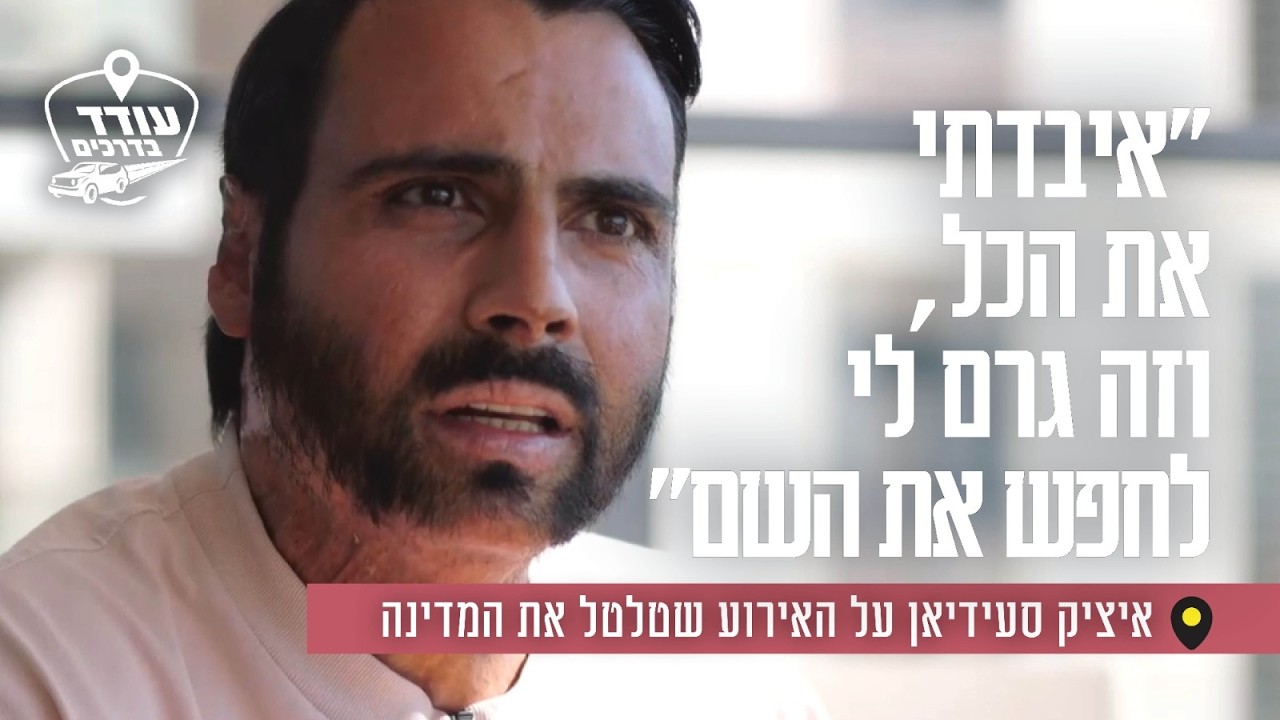
"איבדתי את הכל, וזה גרם לי לחפש את השם": איציק סעידיאן על האירוע שטלטל את המדינה

עודד הרוש פגש את איציק סעידיאן, ושמע ממנו על אסון הנגמ"ש במבצע "צוק איתן", על החוויות הקשות של פוסט טראומה שהובילו אותו להצית את עצמו במחאה מול משרדי אגף השיקום של משרד הביטחון, ועל חיפוש המשמעות בחיים לאחר שאיבד את הכל. צפו
פרקים בסרטון:
בתוכנית עודד בדרכים, עודד הרוש נפגש עם איציק סעידיאן, לוחם גולני שנפצע נפשית באסון הנגמ"ש בשכונת שג'אעיה במבצע צוק איתן, וחמש שנים לאחר מכן הצית את עצמו במחאה מול משרדי אגף השיקום של משרד הביטחון. בשיחה הוא חוזר אל הקרב שבו נהרג חברו הקרוב, מתאר את ההתמוטטות הנפשית והאזרחית שבאה בעקבותיו, ואת המאבק מול המדינה להכרה בפציעתו. לצד זה הוא מספר על הדרך שהובילה אותו לחפש משמעות ואמונה לאחר שאיבד, לדבריו, את הכל.
הקרב בשג'אעיה ואסון הנגמ"ש
סעידיאן מספר שהיה חייל צעיר בגולני שרק סיים טירונות כשפרץ מבצע צוק איתן, ושהוא וחברים נוספים ביקשו בכל כוחם להיכנס ללחימה למרות שכחיילים צעירים לא היו אמורים להיכנס. פציעה של שלושה חיילים ביחידה אחרת פתחה עבורם פתח, והוא מוצב בנגמ"ר אחד יחד עם קבוצת לוחמים, כשחברו הקרוב בן מחליף אותו ברגע האחרון ועולה לנגמ"ש השני.
בכניסה לעזה מתברר שהשיירה התפצלה, ושני הנגמ"שים שבהם היו החיילים התרחקו מהכוח המרכזי. כשהנגמ"ש השני נתקע, שניים מהחיילים יוצאים לחבר כבל גרירה, ואז נפתחת עליהם אש כבדה. סעידיאן, שהיה יורה נגב, יוצא ראשון מהרכב ונלחם מול יורים שנראו בקומה עליונה של בית סמוך.
במהלך הקרב נשמעת פיצוץ חזק, והנגמ"ש השני עולה באש בפגיעת רקטה. הכוח ממשיך להילחם שעות ארוכות מבלי להצליח להתקרב לרכב הבוער, כשבפנים נמצא בן. רק לאחר שהלחימה נרגעת מצליחים לכבות את האש, וסעידיאן רואה במו עיניו את שארית הגופות בפנים. האירוע מוכר כאסון הנגמ"ש, שבו נהרגו מספר חיילים ונחטף גופתו של אורון שאול.
פוסט טראומה בצל השירות הצבאי
אחרי אותו לילה ממשיך סעידיאן ללחום כחודשיים נוספים במסגרת המבצע, ובהמשך גם כחיל סדיר עוד כשנתיים. לדבריו אותו קרב לא היה הטראומה היחידה, שכן גם פינוי פצועים עם גפיים כרותות תחת אש הותיר בו צלקות קשות. בהדרגה הוא מתחיל לחוות קשיי הירדמות, מחשבות טורדניות וחזרות מנטליות על הקרב, ותחושת ניתוק מהמציאות שהוא מתאר כמו עולם עשוי פלסטיק.
נקודת מפנה מגיעה בתרגיל חטיבתי, כשהוא מתעורר מסיוט כשהוא זוחל על הרצפה, מכוסה זיעה ואוחז בנשק. מפקדו מבין שמדובר בתסמינים של פוסט טראומה ושולח אותו לקצין בריאות הנפש, אך סעידיאן בוחר שלא לשתף ולא לספר על מה שהוא עובר, מתוך פחד שיוציאו אותו מתפקיד קרבי ומתוך בושה מהסטיגמה שלוחם שסובל נפשית נתפס כ'לא שפוי'.
הוא מתאר כיצד הדימוי של הלוחם הקשוח מתנגש עם מה שהוא חווה בפועל, ומסביר שמסיבה זו המשיך להסתיר את מצבו עד תום שירותו הצבאי, תוך שהוא מתפקד בקושי. רק לאחר השחרור, כשאין לו יותר מסגרת צבאית שמחזיקה אותו, מתחילה להתגלות עוצמת הנזק שהפוסט טראומה גרמה לחייו.
התמוטטות אזרחית ומעצר
כחייל בודד שהשתחרר, סעידיאן מתקשה לשמור על עבודה או על זוגיות יציבה, ובהדרגה מצבו מתדרדר עד שהוא מוצא את עצמו ישן על חוף הים עם מזוודותיו למשך כחודש. בשלב מסוים הוא חוזר להתגורר אצל אמו, דבר שלא עשה מאז גיל שש עשרה, אך המצב שם רק מחמיר: אמו, עולה מאיראן, אינה מכירה את המושג פוסט טראומה ואינה מבינה מה הוא עובר.
המתח בבית מגיע לפיצוץ, כשהוא שובר רהיטים ודלתות מתוך התפרצות זעם, ואמו, שחוששת לשלומה, מזעיקה משטרה. הוא נעצר ומוחזק כחודשיים בכלא באר שבע, כשהוא חולק תא עם עצורים פלסטינים שאינם בעלי מעמד חוקי בארץ, מצב שמעורר בו פחד עמוק שמונע ממנו שינה, שכן כלוחם שנלחם מולם הוא חושש להירדם לידם.
הוא מתאר את התקופה הזו כשיא של תחושת אי צדק: אדם שיצא להילחם למען מדינתו ומוכן היה למות עבורה, מוצא את עצמו בכלא, נטוש ולא מובן. הכליאה גם פוגעת ביכולתו לקבל את הטיפול התרופתי שהיה זקוק לו, שכן בתקופת המעצר לא ניתנו לו התרופות שנזקק להן.
המאבק מול אגף השיקום
כשנה וחצי אחרי שחרורו, ולאחר שהבין שהוא זקוק לעזרה, מגיש סעידיאן בקשה לאגף השיקום במשרד הביטחון להכרה בפציעתו הנפשית. התשובה מתמהמהת זמן רב, ובמהלכה הוא מאושפז פעמיים במחלקה פסיכיאטרית בלי שאיש פונה אליו. רק אחרי האשפוז השני מגיע לחייו גיא דואק, לוחם לשעבר שמסייע לחיילים פצועים, לוקח אותו לביתו ומסייע לו בתביעה מול המשרד, ובמקביל חושף אותו לים ולגלישה.
דרך אנשים נוספים מתוודע סעידיאן גם לעמותה שמלווה אותו בים ולשיטת ימימה, וכלים אלה מתחילים להחזיר לו מעט נשימה. במקביל מגיעה תשובת הוועדה הרפואית, שקובעת כי הגיע כבר עם פוסט טראומה מהבית, בשל פטירת אביו בגיל צעיר, ושהפציעה אינה נובעת מהשירות. התשובה, הכוללת טבלה המחלקת אחוזי נכות על פי מקור הפגיעה, מעוררת בו זעם עז על כך שאם אכן הגיע 'שבור' מהבית, לא היה אמור לקבל פרופיל קרבי מלכתחילה.
בבית הלוחם הוא נחשף לסיפורים נוספים של פצועי נפש, ובהם לוחמי מלחמת יום כיפור בני שבעים שמספרים שהם נושאים את הפציעה חמישים שנה בלי הכרה. ההבנה שמדובר בבעיה רחבה ושיטתית, ולא במקרה אישי, מלווה אותו ומובילה אותו למסקנה שרק אירוע קיצוני יוכל לחולל שינוי.
אני עושה את זה כי אני מבין שאם לא יקרה משהו קיצוני ואם לא תהיה פה טלטלה גדולה, שום דבר לא ישתנה
אני עושה את זה כי אני מבין שאם לא יקרה משהו קיצוני ואם לא תהיה פה טלטלה גדולה, שום דבר לא ישתנה
ההצתה העצמית כמחאה
סעידיאן מבהיר שהמעשה שביצע לא נועד לשים קץ לכאבו האישי, אלא היה פעולת מחאה מכוונת ומחושבת. הוא מדגיש שאילו רצה לפגוע בעצמו מתוך ייאוש בלבד, היה עושה זאת בדרך אחרת ושקטה, אך הוא רצה שהמעשה יהיה דרמטי וגלוי, כדי שהציבור והמערכת לא יוכלו עוד להתעלם מהנושא.
את המעשה הוא מבצע במכוון מול דלפק הקבלה הראשי של אגף השיקום, במקום שבו נמצא רוב סגל האגף ובסמוך למשרדי ראש האגף. הוא מספר שבאותם רגעים היה מודע לכך שהסיכוי לשרוד נמוך, ושלמעשה קיבל זאת כאפשרות כמעט היחידה, מתוך רצון ש'ייראו אותנו', את כל האנשים שחשים נטושים על ידי המדינה.
לאחר האירוע הוא שוהה כחצי שנה במצב מורדם ומונשם, ולאחר שהוא מתעורר הוא מתקשה זמן רב לחזור ולתפוס את המציאות, כשהוא שואל שוב ושוב מה השעה ואיפה הוא נמצא, כדי לוודא שהוא אכן חי וער.
משמעות, אמונה ובחירה
חמש שנים אחרי האירוע סעידיאן אומר בבירור שהוא מתחרט על המעשה עצמו, ומתאר אותו כביטוי לחוסר הערכה לחיים שניתנו לו, גם אם נעשה למען מטרה שנראתה לו צודקת. עם זאת הוא מספר שדווקא מתוך אותו כאב ואותה דרך קשה הוא מצא משמעות שלא היה מגיע אליה בדרך אחרת, ובהן החזרה לאמונה ולחיפוש אחר אלוהים, שהחלה מתוך תחושה שאיבד את כל מה שהיה חשוב לו עד אז.
הוא מתאר כיצד הוא לומד כיום תניא וחכמת פנים, יוצא לאומן, וגם מתחיל לחבוש כיפה כבחירה אישית חדשה שאינה מגדירה אותו עבור אחרים. שמו הנוסף, 'חיים', שניתן לו בתקופת האשפוז, מקבל עבורו משמעות מיוחדת לנוכח הפסוק 'ובחרת בחיים', ואת הבחירה הוא מתאר כפעולה ממשית ופעילה, לא רק הרגשה פנימית, תוך שהוא מזכיר את דברי רבי נחמן על כך שהעיקר הוא להתחיל תמיד מחדש.
לדבריו, התובנה המרכזית שלו היא שבכל מצב יש לאדם בחירה במה הוא מתבונן, ושמי שבוחר לראות את מה שיש לו יהיה מאושר יותר ממי שיש לו הכל ובוחר להתמקד בחסר. הוא מספר שהוא נוהג לכתוב מדי יום חמישה דברים שיש לו להודות עליהם, ומגדיר את ייעודו כיום בהשראת אנשים לאהוב את החיים ולבחור לראות את הטוב. לצד זה הוא מציין כי הנושא עדיין לא נפתר במלואו ברמה הציבורית, ומזכיר כדוגמה שבישראל פועלים כארבעת אלפים פסיכולוגים בלבד ביחס להיקף הנפגעים, ולדבריו נדרשים פתרונות יצירתיים כדי להתמודד עם כך.
מצאתי משמעות בתוך הכאב הזה, וזה מה שהחזיר אותי על הרגליים
עיקרי הדברים
- איציק סעידיאן נפצע נפשית באסון הנגמ"ש בשג'אעיה במבצע צוק איתן, שבו נהרג חברו הקרוב בן.
- מתוך בושה ופחד מאובדן תפקידו הקרבי הסתיר את הפוסט טראומה לאורך שירותו, עד שהתמוטטות אזרחית הובילה אותו לרחוב ולמעצר.
- לאחר שאגף השיקום דחה את בקשתו להכרה וקבע שהגיע עם פגיעה מהבית, הוא בחר במעשה מחאה קיצוני של הצתה עצמית מול משרדי האגף.
- חמש שנים לאחר האירוע הוא מתאר תהליך של חזרה לאמונה, לימוד פנימי ומציאת משמעות מתוך הכאב, לצד הבעת חרטה על המעשה עצמו.
- הוא מדגיש את כוחה של הבחירה האנושית לראות את הטוב הקיים בחיים, גם מתוך מצוקה וקושי.
מקורות
- דברים ל, יט
שימו לב, הסיכום הארוך נוצר באמצעות בינה מלאכותית. יתכנו אי דיוקים.
Do it, because I understand. I understand that unless something extreme happens and unless there is some huge shock here, nothing will happen; change won't happen. Because if people from the Yom Kippur War that I meet at the Beit Halohem tell me they've been suffering from that injury for 50 years and aren't recognized, then apparently if no explosion happens, if no extreme thing happens — nothing will happen here.
I'll say it in my own words.
Yes.
You are actually willing to sacrifice yourself so there will be a change here in the State of Israel, is that it?
Not just because you reached the point of despair and said so, because otherwise, if you wanted to commit suicide, you could have done it in many ways that wouldn't make such a scene; unfortunately, people do commit suicide.
If it were a matter of " I want to put an end to my pain, " I would have probably done it in another way; that's not the point. Always wearing a kippah? Is that something new? No, it is new, yes.
Wow.
Like, you know.
That's it, because I saw your previous interviews and I didn't see you with a kippah, right?
Yes, actually, this is my first interview where I ...
To honor us? Because you spoke ... no, no.
Actually, it wasn't long ago; it's new that I decided I want to wear a kippah even though it ... It doesn't define me, yes, whether I'm religious or not, but, I don't know, I returned a year ago from Uman and ...
Not for the first time?
Not for the first time, yes.
What happened this year in Uman that made you say " now I want to as well "?
I don't know, because I've wanted to for a long time and ... And I'm saying, if I wear one, does it necessarily define me now? Or, like, I was dodging it so it wouldn't define me, uh ... This year I decided, I said, this is what I want, like, it doesn't matter how other people defined me, so ...
That's on them.
That's on them, exactly, it's not me; I feel like wearing it right now.
And ... That's it, I feel like doing what I want a little bit.
When people call you, there's still that picture with the long hair and, you were a surfer.
Yes.
Is that why you chose to live near the ... do you still surf?
Yes.
Still surfing.
Still surfing, yes, still.
Managing ... you know, as we said, I have my ways; I find my new way to do things for everything. Even with surfing, I have my own way.
I just know that many people with burns aren't allowed to be exposed to the sun. Now, surfers are the most tanned people there are. That's problematic.
I go in with, you know, long pants and a really long shirt, like up to here, and the shirt closes up like this up to here. And protective cream on my face. Sometimes you manage a bit, uh, participating too much. Uh.
When did you go back to surfing? How long since the injury?
Uh. Wow, I think it was back in ... Almost after ... even before I was discharged, I went out a few times, uh ...
To surf.
What does " to surf " mean? You know, being on the surfboard, exactly, standing up and catching the ... not being on the surfboard alone, they pushed me, like, to the wave, you know, not alone, but feeling the sea, the board, that.
Let’s go chronologically, and I’ll tell you in a moment why this idea of yours excites me so much, but I must ask you the question I have no patience left to wait for: do you regret A complex question, really a complex question that I’m asked so much, so many times in my life. Such a complex question. Let’s, let’s, let’s, let’s break it down. Alright? Once and for all, I will break it down. It is an act that is truly That is The opposite of gratitude for the life I was given, it is
Actually, for your existence in the world.
Yes, I mean, first of all, the basis of this thing is, first and foremost, simply a lack of gratitude for the life I received and for what I had in my life, And this Comes from a place where, in the end, in the end. It’s like, when I look at it, I say: how little did I appreciate the life I had, that I was willing to do such an act even for the most righteous justice in the world? So that’s a place where I regret it, where I say: how? How? How could I allow myself to do such a thing? However, There are two aspects to it, where I say that if not for this act, many things would look different.
First of all, is that I see how they treat PTSD today, and shell-shocked veterans in particular, and I And that.
You feel like you have a stake in it.
And it’s something where I, I, you know, I walk down the street and people approach me, and even opening the television or hearing on the radio, today there is, you know, all sorts of discourse about it, and people talk about it, and it’s not invisible. And I understand that there are many people who, you know, are receiving treatment, and the situation is completely different from what it was before the reform. I feel I have a mission, yes, I have a mission in this matter, and I think that, at the end of the day, it saves people’s lives and souls.
That’s why we are here to talk about this thing and
I just have to finish telling you the second thing, which is perhaps even stronger than that, That I feel that the lessons I learned I would not have learned them if not for this path I went through, with all the difficulty and with the fact that I do regret it, but there are lessons and insights I learned that That because of this path I went through, because of the difficulty I went through, I learned them. Like, if not for this, I wouldn’t have learned it. And above all, it is that That I now believe, like, in the Holy One, the faith now And the return to religion is something I probably
wouldn’t have done if I hadn’t, like, if I hadn’t gone through this thing, like suddenly seeking God, really.
Can you explain to me what it was about this event that specifically caused you to seek God?
That I lost everything, like Suddenly, I didn’t have anything to be happy about. You know, until then, I could be happy with, I don’t know, external things, you know, like money or you know. And suddenly I lost everything, like I have nothing, and I sought, like, suddenly I looked for a moment: so, why am I here in the world? It’s like, suddenly I went on a real search. It’s like, searching for a moment for the meaning and why I’m really here in the world. And if I’m here, then there must be some reason. And the first thing I found, first of all, is that, The meaning, like, the concept of
meaning in life, the mission, and that’s the first thing that That moved me and gave me the strength to want to live again.
That is exactly the question. Let me tell you why this meeting between us is particularly moving for me. Five years ago, in 2021, the dear " Dvarot " team and the photographer and I came to your mother. When you were hospitalized, sedated, ventilated, and it wasn't clear yet if you would live at all. Although the first 48 hours were critical, as your mother told us at the time, it was still not clear what kind of Izik would wake up, if he would wake up at all, and we filmed it, we were there five years ago, we were there when they changed your name, we filmed it. And I remember leaving and I’m confessing, here I’m saying, we wrote ...
They added a name to me, but they didn’t change it.
Sorry, they added, important correction, right, Chaim.
Yes, yes, that’s right.
We were there with Rabbi Elnekave when they actually added a name for you. And I am confessing my sins right now. We left there and I said something that is, On the verge of heresy, I’ll say it carefully. And I said to the photographer, " I don't know if it's worth it for him to live. " I didn't believe that a day would come where I would sit opposite you And you would actually tell me that you are surfing, that you returned to faith, that you are in a deep internal dialogue, and that you are cognitively amazing, sharp, articulate, saying things. I didn't believe it could happen. So first of
all, it moves me because you taught me a lesson in faith. I, who supposedly come from a place of, you taught me a lesson in faith that truly everything is possible, so first of all, this meeting with you moves me, thank you.
I think, yes, it’s amazing that you say that because I waited for, I mean, I’ve done many interviews, you know, and I waited for this interview with you, I think this is the interview, yes, I think that ...
Why, what did I merit? The fact that you are saying what you are saying now, as if it’s so real, that you are real, you aren't Trying to force words, it’s like ... It’s like you are authentic, you are bringing yourself, and that is ... I waited for this interview because I knew that this one, more than any other, would be real.
Wow, you moved me, thank you. So we went back five years, but let's go back, with your permission, not five years.
Five years ago your life changed, but another event preceded it.
Operation Protective Edge. Do you remember? Can you take us back to what was there?
I had just finished training. In Golani. In Golani, yes, we moved up to the battalion. And we hadn't, we hadn't gone home yet, we moved to the battalion and hadn't gone home yet, maybe a week or a week and a half passed and we already went down to the staging areas.
Toward
Toward combat, yes, we went down to the staging areas, and at first, because we were young, we weren't supposed to enter into combat. Um. We, me and two other friends and a few more, talked and really wanted to get into combat. We spoke with the commanders, anyone we could, to get into the fight, saying we’d go in no matter what, in any role, the main thing was to get in.
In the end, you were trained to be a combat soldier for that.
Yes, that’s what we wanted to do, you know? We wanted to get into combat and do our duty. But in the end, they told us we weren't going in, and they started moving towards, towards Gaza. I remember me and two friends just sitting there crying, really crying over the fact ...
That we aren't going in and they didn't take us, and we’re just sitting there in a circle.
Not crying that we’re going in, but crying that they aren't taking us.
That they aren't taking us, exactly.
Wow, just sitting in a circle like that. I can picture the situation, crying, crying, and ... Going to sleep. We wake up in the morning, and suddenly we see the whole battalion starting to return. We hear from the battalion that they didn't go in after all, and there’s a 24 - hour delay. My two friends and I talked to the commanders again, and we really pushed as hard as we could. And ... And, by luck or not, they told us there was an accident in the battalion, three soldiers were wounded, and they needed three soldiers. So, they took me and two other friends at the start. We went to a
platoon that wasn't ours, and they split the forces. I was supposed to enter in one Namer, Dor, my friend, in another Namer, and Ben was supposed to go with the battalion commander or something like that. We did the final briefings before entering, you know.
Night had already fallen. Yes, final briefings, we ... We're about to get onto the vehicles, and suddenly I see Ben come over to us, saying the commander decided he’s going in with us instead. And then, the platoon leader told me: " Switch, you go with me in the Namer, and Ben goes in the other Namer. " We started moving towards ... we got into the vehicles and started moving towards Gaza. Going in. Slowly, slowly. Really, as time goes on, we start to realize we are actually entering a war. You know, before that, you don't really understand what war is, but as you go in, you suddenly hear on
the radio: " I’ve been hit, I’m wounded, I need evacuation. " Suddenly you hear all the explosions around you. Slowly, you understand where you're entering. Um. While we're going in, we realize that ... That we lost ... we were in a convoy with tanks and everything, and in the process, we realize we got lost, that our two Namers got lost.
Wow.
And they aren't in the convoy. We arrive, even though I don't see it. Yes, I’m telling you everything as I understood it later. Then, we probably entered some olive grove in Sajaiya and ... The driver of the second Namer gets on the radio and says, " I'm stuck, I'm stuck, I need a rescue. " Two soldiers from my Namer get out and hook the other Namer to a tow bar, it's like a cable that connects it to the vehicle. Just two or three minutes later, we suddenly hear heavy fire, bursts of gunfire.
Towards you.
in our direction, we see the bullets, streaks of fire, I see the officer start to shoot, start to shoot. And he essentially tells me, " Negev, Negev, dismount. "
I am the first, I am a Negev gunner, yes, I am the first to exit from the ...
from the APC, I start shooting toward a house that is literally maybe 10 meters in front of me. I see Kalashnikovs from the top floor shooting in our direction.
I start shooting at them, bullets are literally, you know, passing like this, passing by me, and I, you know, have a Negev, so I sprayed the house. I see that it starts to — they started, as if they moved away from the windows, the firing stopped. We start telling them, " Let's move, " we start dragging them. While we're dragging them, we hear a serious boom. I jump out of the APC. I see the second APC going up in flames.
Did it get hit by an RPG?
RPG. During this, I ... we start again, they start shooting at us again. I am engaging them in a firefight. Our APC starts to move forward. Move forward a little more. During this time, we start ... then we start to dismount and then we got into a very difficult fight there, because they were inside a house, they were at a height above us, and we were below. Two more soldiers were wounded, and during this whole fight, the APC that is in front of us ...
is burning.
Is burning. At first, we didn't exactly understand if everyone who was there remained there or didn't remain there. Uh, slowly we realize, we see the officer and the soldier who was his radioman, and he essentially says that they didn't manage to dismount. And while doing this, we are also managing a fight, like, they are shooting at us, and the officer is wounded in the leg, and everything is like, everything is in some kind of madness, like everything is a whirlwind of emotions. And ... And essentially, uh, we are waiting for the whole night, the whole night that APC was burning, uh, forces join up with us and then ...
It is burning while there are fighters inside.
You aren't managing to rescue them?
Not managing, not managing to get close at all, because we are somehow behind the APC. They are shooting at us, we are in a fight against them and the APC is really close to the house, so it's impossible to get close to that area at that time. I realize that, you know, that my friend, uh, Ben, uh ... is there. Uh, like, you know, it's really seeing as if yourself is somewhere there, because you, you, you were supposed to be there. And after it's over, the fighting is over, we bring fire extinguishers, we extinguish the APC. Uh, I remember that there, that literally while I am extinguishing
the APC, like, like, like I saw Ben like that there. And. You know, it's in the end, don't want to, don't want to, but in the end you see some sort of, you know, people there inside. Yes, it's not, not much remained of that, but you see people in the end. Wow.
Uh ...
That's what is known as the APC disaster, right?
Yes.
Meaning, this is one of the most dramatic events in the recent wars and particularly in Protective Edge.
In Protective Edge, it is the ... It is a disaster, uh, yes, the result of which ...
seven dead and Oron Shaul was kidnapped.
Also, Boron Shaul was killed, maybe eight, but uh, they didn't get to write it down. Yeah.
What does it do to you to go back, to tell it, to remember it? Is it hard for you, or because you've told it so much, it's already ... There's a difficult aspect to it, and there's also ... That it's ... Part of my life already. Like, you know, that's it, you say it's part of my life. But uh, in the end, what led you to do what you did five years ago is because you didn't accept that it would be part of your life. You reached a point where ... That you aren't willing for it to be part of your life; how were the years?
It’s not that I didn’t accept that it would be part of my life.
Yes, it was very hard for me that it’s part of my life, yes, uh ... I went through a journey. Not simple. But it's not because I didn't accept that it's a part of it, but because they didn't see.
So that is exactly the question.
Describe to me the years from Protective Edge to that act, the act where you decide to set yourself on fire — we'll touch on that in a moment — but what leads you to commit that act? What happens in those years between Protective Edge and the moment of ignition?
So, actually, as I told you, Protective Edge was right at the beginning of my military service.
After I came out of Protective Edge.
I continued to be a combat soldier for another two years, uh.
You went back to fighting in Protective Edge?
Did we continue fighting? It was the first day.
It was the first day, we continued a month of fighting.
Right, it was a war compared to ... it was 54 days.
Exactly 54 days, almost two months then. So that event, the Namer APC, which was, let's say, the most defining event, or the severe trauma I experienced in combat, but it isn't the only trauma. Because during the fighting, I participated in other battles and saw very difficult sights, especially in evacuating the wounded. I evacuated, we were in an incident of evacuating wounded, and I saw very, very difficult sights of friends whose arms and legs were severed, and I had to evacuate them under fire, which are also very difficult events and also war events, uh, uh. Later, in the almost two
months we were there in the fighting, actually after we came out of Protective Edge, uh, we returned to the battalion. You know, what a combat soldier is expected to do in the battalions is to take shifts and stand guard, uh, and slowly ... Slowly, uh, I started to feel and experience symptoms, uh, in ...
What does that manifest as?
Mostly, it manifests as ...
Uh. At first, it was not being able to sleep, I found it very hard to fall asleep, many, many thoughts.
About that, or generally, mostly, mostly specifically about that event, specifically, uh. Many, many regrets, many, many regrets.
About what?
About what happened with ... you know, as I told you, like, we kept going even though we shot at them, all sorts of questions: what could I have done?
Or why him and not me? And like, I was very, very close to Ben. To this day, I am very close to Ben. I, Ben is a character you can't explain; he is a very beloved character and very human, a true warrior. And like, I was also very, I heard a lot of thoughts, a lot, a lot of thoughts that made it hard for me to sleep and cut me off many times, you know. And my platoon didn't participate in the fighting, as I told you, just me and two friends, so I returned to the platoon.
That wasn't in the fighting, and I also couldn't, they really couldn't understand what.
How exactly do you explain to them what you're experiencing? You sit with them in the barracks and you experience some kind of detachment, and you can't explain to the friend next to you what you're going through. I'm like, sitting with the company, but I'm not really in the company, my head is somewhere else.
Does anyone see it?
Someone, slowly, slowly, slowly, they realize that suddenly, you know, I'm not falling asleep. Suddenly I'm awake at 4:00 AM, my officer passes by, suddenly, you know, asks me what's going on with you. My officer wasn't exactly in Operation Protective Edge either, you understand? So like, try and explain that to my officer too, and ... Slowly, at first, I don't give it a name, I'm just, you know, a person with many thoughts and all sorts of things. Suddenly I start getting angry and start getting upset by any little thing that happens, you know, out of all proportion. Suddenly I start crying,
when it's just for nothing, suddenly very emotional, very, very emotional, lots and lots of thoughts and just unable to fall asleep. And slowly, over time, I start to experience it a bit at night, suddenly some nightmares, and all sorts of small symptoms, mainly emotional detachment, mainly some kind of emotional detachment from the world, like experiencing the world as something external, as something, as if I'm in some, it's not real, a bit in your own bubble.
Exactly a bubble like that, like the world isn't, it's like plastic, it's like a game here.
Like, how does it make sense that I was there and now I'm here, and like, life is just, such a detachment, and slowly I'm having nightmares until one day, during a brigade exercise, I wake up while my officer is waking me up. I'm lying on the floor, crawling. I was covered in sweat and with the Negev in my hand. And I literally wake up from a nightmare, literally experiencing a nightmare in every sense of the word. Like.
Do you remember it? I remember that nightmare to this day, like it's more or less the same nightmare, uh. It's actually that incident with the APC more or less, and that's where my commander realizes that I ... Am experiencing PTSD and sends me to a mental health officer. But I don't, I don't tell, I don't share anything with the mental health officer.
Why?
Because I, because I don't want them to take me out of combat. So I just tell him all sorts of other things, but I’m not really ready to admit it, and I don’t tell him, I don’t tell him too much about what I’m experiencing. But
You were ashamed?
Uh, I was also ashamed. Yes. Mostly I was ashamed. Mostly I was ashamed. Like, you know, there’s this stigma where, what am I going to say, that I’m suffering from PTSD, so I’m mentally ill, you know?
And it also doesn't suit warriors, we are men, we are tough.
Exactly, exactly, exactly. I’m a warrior, I’m like ... I fought for the country. Now they’re going to turn me into some crazy person or someone who isn't okay, and mostly, I also didn't want to be removed from my position, I didn't want to be taken out of combat duty. So I wasn’t ready, so I kept on being in the battalion. It was a bit hard for me, I had some problems, difficulties, mostly, you know, in managing things, but. I survived the service, I finished my service as a combat soldier and.
At what stage do you say, " I have PTSD, I acknowledge it, I can say it, and I also want recognition from the state "?
It’s a long process, it’s a long process, because after I was discharged, I started to truly understand how much this PTSD is damaging my life; because when you’re a soldier, you have missions and you, you know, you don't have to live for yourself, you have things arranged for you. When I was discharged, uh, and I was basically a lone soldier, so, until the army helped me with rent, helped me with all sorts of things when I was dis – discharged. I had to.
Start looking after myself, yes, to work and support myself and
You know, to live, and I started working, and another job, and another job, and another job, and I couldn't hold down a job, suddenly I’d get into a relationship and I couldn't keep the relationship going, and slowly I started, like, I started to deteriorate until I really had no money for rent and And I was I was living at the beach,
Sleeping at the beach.
Sleeping at the beach. Yes. Uh, like that for more or less almost a month. Walking around with suitcases and sleeping at the beach. Uh, and there I basically decided that I would return to live at my mother’s. Which I hadn’t done since I was 16, more or less, I hadn’t lived at home. I decided that I was going back to live at my mother’s and And the situation didn't get better, it just got worse, because when I returned home, my mother didn’t know exactly, didn’t know what PTSD was, didn’t know, they didn’t know what you were going through from the field, friends
Knew that I was in the war, knew that, but like, also think about it, in terms of awareness in society in general, PTSD was something that was, like, inconceivable, skeptical. So, certainly, my mother, who is an immigrant from Iran and who doesn't at all, like, know more or less what PTSD is, so she was even more – you know, the situation became difficult. And I exploded at home, really I broke things, like, I exploded at home, I pulled out cabinets and broke the bedroom door and I just really, really exploded. And you know, uh, I also kept, like, I was really, I exploded at home. And my mom
called the police, and some officers arrived. And they took me to the police station, they put me in jail.
Wow, why? Because she thought you would hurt your mom?
Yes.
The family, the family incident put me in jail. I was in Be'er Sheva prison, in Be'er Sheva prison.
For how long, more or less? Two months.
Two months you were in jail.
Two months I was in jail.
A warrior that just no one understands.
Exactly, that no one understands me.
Wow, how frustrating.
And I'm sitting there with people who, with, with Palestinians, they put me in a cell with Palestinians, with people who are illegal Palestinian residents.
The ones you fought against?
Exactly them. Think about me sitting inside a cell, post-traumatic, with an illegal Palestinian. No, no, I didn't sleep there for about, maybe a week, I couldn't fall asleep, I couldn't close my eyes because I was afraid, like, I was afraid that if I closed my eyes, this Palestinian, I don't know what he would do to me.
Were you angry at your mom?
At the time, yes, at that time, while I was there. Yes. And basically I was there for two months, and I had, you know, after I was released, I got a little help from a psychologist even though they weren't yet recognized, but I had pills I used to take. And during the time I was inside, they didn't give me my pills, and no one cared about me, and I tried to reach out to all kinds of people in prison so they would understand me, help me, and no one helped me and no one talked to me. And I really reached a place where I was, like ... I said: Like, how, how did I get to this place? Like, I, who
went out to fight for the people of Israel, who risked, was ready to die for the people of Israel, am I sitting here in jail with illegals? And there, basically, after I was released, after I was released from prison, I decided that I want — this is talking to you about a year and a half after I was released from the army — yes, that's where I decided that I want, I need help, and there I submitted a request to the Rehabilitation Department at the Ministry of Defense to recognize me. And. Whoever knows the process knows that it's a process, uh, it's not like you submit a request and they get
back to you right away. So basically, after I submitted the request, time passed, you know, time passed, and I didn't receive treatment during this time.
You didn't receive treatment and they also don't get back to you?
They don't get back to me. I'm waiting for them to get back to me, there's no answer, no one talks to me. And during this time I'm going through more, more, you know, more things. I went into the ward, uh, to the inpatient ward twice, uh, I go out, I go in, I go out, and during this time still no one talks to me, my situation is just getting worse. Uh, basically after the second hospitalization I had, basically after the second hospitalization, I understood that, like, my mom already, uh, it was already hard, hard for her for me to return home after all that she went through. And then a guy named Guy Duak arrives, who takes me to his home; he is also a combat veteran.
Who is that? How did he reach you?
A combat veteran who helps other combat veterans.
Uh, actually, he reached me through someone who was also helping me, someone who has an association that was helping me through it, and he arrived, arrived through her, actually came to the hospital ward after I got out of my second hospitalization, takes me to his home and really helps me, with the claim against the Ministry of Defense. And he also introduces me to the sea. He is the first person who introduced me to the sea, to surfing. And at the same time, after he introduced me to surfing, I also met a group of combat soldiers that meets, and like, since I got to him, I started going through some kind of rehabilitation process.
But that’s still not the state — it's private individuals.
Private individuals who helped. He mainly, he mainly exposed me to the sea and exposed me to all sorts of things, and an association that I visit once a week at the sea, actually, and another association that introduced me to the Yamima method, if you’re familiar.
Of course, the Yamima method.
The Yamima method.
Yes, Rabbanit Yamima.
Rabbanit Yamima, and slowly, with these tools, I start to breathe a little, like, a little.
Wow.
And at the same time, I receive an answer from the Rehabilitation Department — like, in parallel to this guy helping me, I reached a committee, I did a committee, and I get an answer from the committee that basically says that I already came messed up from home, I already came with PTSD.
It has nothing to do with Operation Protective Edge.
Exactly, they say it’s not — they really brought me a page, like a reply sheet with a table where it’s written: on account of service, not on account of service, like, on account of service 25 %, not on account of service 25 %. Basically, it said I arrived from home already with PTSD.
If you arrived like that from home, why did they make you a combat soldier?
Exactly, why did they draft me with a 97 profile at all?
They — they defined that I had a 97 profile, right?
Right.
At the first draft, you defined that I had a 97 profile, even though ...
I am suitable.
Listen, I am suitable, exactly — if you — if I already came messed up, you shouldn’t have given me 97 %.
You should have given me 60 — I don’t know how I was fit, why I was fit to enter and fight for you and die for you. And after I get out of the war, and I could have died for you — I was supposed to be in that armored personnel carrier. If I had died in that armored personnel carrier, then everything would have been fine, right? But when I stayed alive, I stayed, I survived that thing, and I — I stayed alive, and today I need your help, you turn your back on me. You say that I came already messed up from home, okay, I said okay, you would say I’m 30 % okay. But this thing that you say that —
like, you bring me a page with a table: what is on account of service and what is not on account of service.
How did they understand, how — how did they even determine what is on account of service?
They said that because my father passed away at a young age, I was already post-traumatic.
Then it’s your problem that you didn’t discover that before my service and tell me: don’t be a combat soldier, don’t be a fighter.
Exactly. And let's put it this way — who among us doesn't go through things? Who among us doesn't face hardships in childhood? Who among us has a perfect life until they reach the army? Everyone goes through stuff; it’s not just me. And what I’m saying is that I slowly began to realize. I arrived at Beit HaLochem after they recognized me, and I would come there too.
Wait, when you receive that diagnosis ...
What is your initial feeling? My initial feeling? I have to put the feeling into words?
Yes.
Rage. Just like ...
Like you were discarded.
Like some, like some, like some piece of trash on the floor, just thrown on the floor. Used and thrown away like that. But with all the anger and all that difficult feeling I was experiencing, I didn't want, I didn't want ... you know, I somehow started to live a little. I didn't want to, I didn't want to. I knew that if I started obsessing over this now, I’d quickly return to where I was — quickly return to the streets, back to hospitalizations, back to, God forbid, prison. Now, if I enter this battle against them, while my soul is still broken and I’m barely starting to recover, I’ll be
entering a slippery slope that could lead me right back to where I started. I said, " Okay, I'm holding on to these two things I have: the sea, and the study that develops me, that calms me down a bit, and builds my resilience. " I hold onto that and I take whatever I can from it right now. And slowly I started coming to Beit HaLochem and hearing stories. I began to hear how, how it’s not just me, how there are thousands of people whose injuries aren't recognized.
Because it’s mental, not physical. Exactly. I started, I was exposed to this, to how transparent a mental injury is, and how disregarded it is. And suddenly other people were sharing that the same thing happened to them, that they were told they came from home already " broken, " and slowly, you know, I started to understand it all. And slowly I met people who would come to Beit HaLochem and tell me stories, that, that, you know, they got divorced and their wives won't speak to them. And people — I realize how, how this thing really is — people from the Yom Kippur War, suddenly I meet people
aged 50, 70, who say they’ve been carrying this injury for years and no one sees them. And, you know, I’m exposed to this and it still resonates within me. It’s not like I said, " Okay, I'm leaving this behind, " and moved on; it still burns inside me. I will say that the issue of justice is ... it’s an issue.
Obviously.
It's a very, very big issue for me.
That they acknowledge me.
Not just that, not just that, in general, the issue of justice is a very personal matter for me, very, very, very much so from the beginning of my life, from the time I can remember myself as a child too.
But recognize me, not in the context of me wanting money, but in the context of
of
That is the truth
Right, that is exactly the truth
The truth, what we will do with the next step
Exactly, exactly. It doesn't interest me, like, what you give or don't give — it doesn't interest me. It doesn't interest me. I also submitted another request afterward, because after that answer I filed an appeal, that’s what it’s called. Also in the appeal, they didn't accept my appeal, they told me it's the injury. Even though I didn't place too much importance on the appeal because they told me: " Forget it, this appeal won't work, " but I filed it anyway and. And exactly as you say, it didn't interest me what. It interested me that they recognize my injury, that they understand that the nightmares and the difficulties I experience are an injury. That what I'm carrying, exactly
That what I'm carrying with me
Is because I went out to defend the people of Israel, that they recognize my injury, that they recognize what I did.
You describe on one hand a struggle and a process of self-healing, not through the state, the Yamima method and good friends and associations. On the other hand, the state doesn't recognize, doesn't recognize you.
So you do manage to keep your head above water, literally, you start surfing and so on, when does the point come where you say " Enough, I'd rather die than live "? It just doesn't have, like, it's not like something happened and then I said " now this will happen, " it just ... This place of justice just wouldn't let me be. It wouldn't let me be. And as time went on, it only, it only grew and grew and grew and grew and grew. And more stories and more people and more. Suddenly I hear about a person who lives on the street and I go and I help some ... there was some guy who was living on the
street, I would go to help him a little, and suddenly I meet more people and I see how much, like, how transparent it is, how much people are experiencing this injury and they don't see them.
They ignore them. They really ignore them and it's like, and you say, and you walk down the street, and on one hand, like, you know, I also lived in Tel Aviv and such, and I had friends who lived in, like, luxury, who didn't even serve in the army, and they make money and everything, and on the other hand, I meet these friends who fought for the people of Israel.
An upside-down world.
Exactly, an upside-down world, exactly an upside-down world and simply.
You're doing this, Itzik, because you say, " Enough, I can't take it anymore. "
No, I'm doing this because I understand. I understand that if something extreme doesn't happen and if there isn't some huge shock here, nothing will happen, no change, it won't happen. Because if people from the Yom Kippur War, whom I meet at the " Beit HaLochem, " tell me that they have been suffering from this injury for 50 years and they don't recognize them, then apparently if some explosion doesn't happen, if something very extreme doesn't happen, nothing will happen here.
I’ll put it in my own words.
Yes.
You were actually willing to sacrifice yourself to bring about change in the State of Israel. It’s not just because you came to me and said so, because if you had wanted to commit suicide, forgive me, you could have done it in many ways that wouldn't have made such a scene. People commit suicide, unfortunately, it happens.
If it were a matter of wanting to end my pain, I probably would have done it some other way. That’s not the point, not at all.
It was important to you that it be shocking.
It was important to me that it be shocking, and that it happen right there in front of the people who walk into the Rehabilitation Department head's office. It was right in front of the Rehabilitation Department head, inside the department itself, at the main desk, right in front of the main reception area of the Rehabilitation Department, where most of the department staff sits.
When you perform this act and set yourself on fire,
in those moments, do you realize there's a very good chance you won't make it out alive?
That’s right.
You took that into account?
Not only did I take it into account, as far as I was concerned, it was, it was almost the only option. I mean, I recall that when they saved me and I stayed alive and kept on going, the thought crossed my mind that what I tried to do didn’t really work. I mean, for me, it was, it was " let my soul die. " I mean, for me, it was about going, and, and that this justice, and these people, and that we, the people who were abandoned by the State of Israel, who walk among you, that no one sees — let them see us. Let them see us.
Actually, when you’re fighting for your life and they save you in the end,
Yes.
do you remember the first thought that goes through your mind when you open your eyes in the hospital? " What a bummer, it didn't work " — what was the thought?
No, there, when I was with the bandages and they were keeping me alive, that was exactly my thought — that maybe it didn't work, that I hadn't succeeded in what I tried to do. And when I woke up, when I woke up, I didn't quite understand what was happening to me.
How long were you ...
I was half a year,
sedated.
Sedated and intubated, yes. When I woke up, I still didn't quite understand; you know, you could say that somewhere, I didn't think I was here, I thought I was there, like ...
Yes, I saw my mother, and at first I asked them: " What’s happening? " Like, " Where am I? " And even after half a year when you wake up, it takes a long time to process reality. It’s like, even what you see with your eyes, it takes time, time to really see. It’s like, you don’t exactly understand where you are, and you keep asking them: " What time is it? " " What time is it? " " What time is it? " — just to see that I’m really in reality.
Five years, five years have passed since that event. You already said at the start of our conversation, " I don't recommend it, I made a mistake, there is a lot of ingratitude to life in it. " Yes, it’s a mistake, no one should do that for any kind of justice.
And yet, I want to ask you: Did you succeed?
That depends on from which perspective you look at it.
The struggle for which you agreed to sacrifice yourself, so that those with PTSD wouldn’t be neglected by the Rehabilitation Department and the Ministry of Defense. This struggle you embarked upon, you won it.
Today I realize that it wasn't me who won it, it was God. God did everything. God arranged everything. But to your question, I won big. But it isn't me. Because today I understand it’s not me. It is still doubtful if the State of Israel is truly ready to enter this story with full force and genuinely treat this issue, because this issue will require budgeting double or triple the current funding the Rehabilitation Department receives; they will need to invest resources, time, and attention, and I tell you this from my experience and my two and a half to three years of activity, as I am active
in the Knesset and show up. I still don't believe with all my heart that the State of Israel, the Ministry of Defense, and the Israeli government are truly ready to take this on. Because this story, now after October 7th, is very complex, and I will need to bring truly creative solutions to it. Because
You know Itzik, you say it’s complex, and I think it’s very simple. It is not complex. The State of Israel sent people to defend. The war is over there, it is not here. The war is in Gaza, the war is in Lebanon. The war must not be here.
The war must not be here. And I want to believe, let’s say that we are in a different place, but we didn't just come here, all the way to you, to voice this, because there is clearly more to be done.
I will give you one example. For instance, today in the State of Israel, there are more or less 4,000 psychologists. 4,000 psychologists for the amount of PTSD sufferers we have here in Israel today is more or less one per 10,000 people. To bring more psychologists to the State of Israel, we need to bring a creative solution. Train them quickly, give them a fast track, recruit them quickly, provide them with larger budgets. That is what I mean by creative solutions. We need to think outside the box for a moment, because the current situation ... If we continue like this, it’s just ... we will
reach some kind of abyss that that will lead us to a place where, likely in the end, the State of Israel will understand, you know, as we are accustomed to — only at the end, after something happens so that we won't have another Itzik Saidian who chooses these extreme actions. Five years since that incident where you set yourself on fire in front of the Rehabilitation Department, five years of a journey. Part of it you were between heaven and earth, part of it you are here. What, what are your insights from these five years?
So as I told you, there are a few insights. The first insight is that despite the fact that in the end, you know, it is a place where there isn't anyone who didn't understand the matter of this justice that burned in me, and in the end, of thousands of people who walked around here and whose injuries weren't recognized. I, myself, like, when I, you know, when I sit, lie down at night and think about this act, I really, truthfully tell myself that no, I probably didn't appreciate the life I had enough. Like, you know, for myself, in my own truth, something I tell myself is, if I had — probably
if I had truly valued my life, I wouldn't, I wouldn't have done what I did. The second thing I realized, and this is what got me back on my feet and it’s — like, it’s thanks to this that I’m standing here today, is that I found meaning within this pain. Like, the meaning of finding a purpose in life, finding something that gives you a reason to get through life's hardships, is really, maybe the most important thing in life. More than anything else, more than
having meaning in your life,
having meaning in your life. People want, you know, before that — before that I said if I had money, then I’d be happy. If I had a nice house, which has no connection.
Yes, no connection. Exactly, exactly, exactly. If a person finds the meaning, the purpose, that is
What is your purpose today? My purpose today is, it's to inspire people to love life, to love what, to value what they have, to choose meaning, to choose to ... you know, I told you, I surfed before and days, today I do it full power, like I'm all day, I’m studying Tanya. I told you, I study Hasidism, I study inner wisdom. Like it’s a thing, in the final moments of your life, the moment you’re between life and death, you won’t — you won’t say what kind of house I lived in or what ... that — it won’t interest you. You’ll care about how much you developed internally, how happy you were, how
much you worked on yourself from within, how much you created small moments of riches to surf, to do things. Like that’s what will interest you at the end of your life. And the thing, maybe the most powerful, maybe the most powerful thing I understood from this process, is that in any given situation, at every moment, with all the difficulty, no matter what you’re going through, we have a choice about what we choose to see. Like this matter of choice, this matter — it’s what the whole world rests upon.
Because you could have You could have, no, you could have nothing, but if you choose to see what you do have, you will be much happier than someone who has everything and chooses to see what they are missing, it’s like ...
It’s the essence of the world, like the first man, the Holy One, Blessed be He, didn't judge him for the mistake he made, not choosing. He judged him for not choosing to say " I was. " You understand? Like the choice, this matter of choosing, to be real and like choosing what you see, like the hope or the despair, like this matter is something that accompanies me in all sorts of little things in life. Suddenly, I don't know, I wake up on one of those down days, like I say, okay, well, the day is wasted. Like, okay, the whole day is going to be ... and then I remember this thing where I say,
okay, it's my choice what I choose: do I choose to tell myself, that's it, my day is ruined, or do I choose to tell myself, okay, it started off bad, but God willing, today I'll try to make it, yes, make it a good one.
And not just change it, it might even be that the day itself won't change, my perspective exactly, the conditions might not change, but my choice of how I look at it, and then the next day, even if it doesn't change on that same day, the next day looks different, you know, as you persist in this matter of choice.
And like, you have to work at it, people. Like, it's a shame we have to lose, it's a shame we have to lose things in life to appreciate them. You can do it even before you lose them, work at it. You know, today I write down, thank God, not always, but I try every day to write down five things that I have. And thank God I have, like you know, in the end I have hands and I have feet and I'm breathing and I'm talking and I see and I hear. And like, all of this, even though I'm ultimately injured, yes, but there are things, I have a home. And like, we need to choose to see, to see what we do
have. Like, there will always be more, we'll always want more, it's never perfect. But this matter of choice is like ... there's a saying by Rabbi Nachman, he says, and this is the point, that even there I chose, I chose to live. I also call my lecture " I Chose to Live, " because I really did choose. It’s something perhaps purely spiritual, but it’s as physical as it gets. To choose is like an action, it's really an action.
It's amazing that you say that because the name they added to you is Chaim ( Life ), and it's written " and you shall choose. "
Life.
Life.
Right, you chose, a truly active choice, you have to choose.
Exactly, really active, really, really. And how does Rabbi Nachman say: The main thing is to start from the beginning, the main thing is to start from the beginning. Like, I could have been there, finished in bed, exactly, I could have been finished in bed and said: How? You did. And I was in that period, how did I do it and how did I reach this, and what? I did. But the moment I chose, I chose life; it was like I said: It happened, I'm starting from the beginning, like. Yitzhak Saidian, we are happy that you chose life and that you continue to spread good and encourage people to choose life and choose to see the good. Thank you for hosting us, thank you for the connection.
Sure.
A great privilege, thank you, thank you.
התמלול נוצר אוטומטית ועשוי לכלול שגיאות.
פרקים
13 פרקיםפורסם ביום ראשון, ז׳ בחשון התשפ״ז (18.10.2026). משך: 57:03
20 תגובות
תגובה מתפרסמת אחרי אישור של המערכת.
אייש מדהים, תצליח!!!
איציק אתה פשוט אדם חכם מלא עוצמה ועודד שואל כ"כ ברגישות פשוט ראיון מדהים מאחלת לך בריאות איתנה ושתזכה תמיד להיות שמח ממש התרגשתי .
תודה רבה רבה
מרגש מאוד, מחזק מאוד ומחייב
ואו ואו ואו
איך אפשר ליצור קשר עם איציק?
ראיון חשוב ביותר ומחזק מאוד ! מפעים ועוצמתי ! תודה רבה
איש מתוק!!
איזה איש מיוחד ומתוק
אמתתת
מרגש
חבל
ואוווווו אני בוכהה
אני מרגישה שהראיון הזה נוצר בשבילייי
תודה שחיזקת ומחזג
מאחלת לך וכל עם ישראל בריאות הנפש והגוףף
וביאת משיח אמןןן בקרובב
כל כך עמוק ומלא תובנות. אשריך.
מחזק מאוד! אשרייך על הבחירה כל רגע מחדש. העולם נברא בשביל הניסיון והבחירה!
במקום שבעלי תשובה עומדים צדיקים גמורים אינם עומדים...
ושיהיה לאמא שלך נחת. זה מצווה חשובה
is that not once did he mention the beyond-unbearable physical pain of burn treatment, which is a very strong proof of his inner strength.
הסרטון נחתך לא יד הסוף!
זה נחתך באמצע!
ראיון מדהים
צדיקים
וואהו איזה רעיון כל הכבוד לך יצדיק